
📚 My Bookmarks
No bookmarks yet
Use the chapter navigation to jump around this report.
Strategy (MSTR): One BTC Pool, Six Layers of Securities
Strategy / MicroStrategy (NASDAQ: MSTR) Equity Deep Research Report
Analysis Date: 2026-08-24 · Data Cutoff: 2026-08-24
One BTC pool, six layers of securities. Strategy's core capability is to take the same Bitcoin risk and slice it into securities with different seniority, cash yield, maturity profile, and upside elasticity, then distribute those securities to investors with different risk preferences.
Strategy is often described as "a listed company that holds Bitcoin with leverage." That description explains the asset side, but it does not explain how the company finances itself, what holders of different securities actually receive, where cash dividends come from, or whether incremental BTC ultimately belongs to common shareholders.A more accurate description is:
Strategy is a listed capital-structure conversion platform. BTC is the asset base; security design and capital-market distribution are the production capability; the same BTC risk is sliced into different levels of seniority, cash yield, maturity, and upside elasticity.
Creditors buy a higher claim in the payment waterfall and a call option on MSTR. Preferred-stock investors buy different grades of cash yield. Common shareholders receive the final residual value and the largest upside elasticity. The company exchanges these securities for dollars, then uses those dollars to buy BTC, build cash reserves, repurchase securities, or manage debt maturities.
Whether this structure can keep creating value depends on three linked questions: whether BTC's long-term return can cover the cash burden; whether the MSTR, convertible, and preferred-stock markets continue to accept new issuance; and whether, after debt, preferred claims, and dilution, the common shareholder's net BTC claim per share increases. The first decides whether the asset appreciates. The second decides whether the company can keep producing capital. The third decides whether common shareholders actually benefit.
Chapter 1: Start With the Conclusion
As of August 16, 2026, the company held 840,447 BTC and $4.8 billion of USD reserves. Its June 30, 2026 quarterly filing showed about $6.714 billion of convertible principal and about $15.462 billion of liquidation claims across five preferred-stock classes. After a series of STRC repurchases, the mid-August nominal preferred-stock claim had fallen to about $15.1 billion, while annualized cash needs for debt interest and preferred distributions were about $1.72 billion. Assets, liabilities, cash obligations, and market prices come from different cutoff dates. They should not be forced into a single balance sheet that looks precise but is actually mismatched. 2026 Q2 Form 10-Q|August 17, 2026 Form 8-K
The conclusion can be compressed into nine points.
The company is currently closer to a state of ample asset coverage but capital-market-dependent cash flow. The market value of BTC and USD reserves is clearly above the nominal claims of debt and preferred stock, but BTC itself pays no interest, and the software business is not enough to cover the cash needs of the entire capital structure.
Common stock does not directly own all BTC pro rata. Debt and preferred stock are paid first. MSTR receives the residual value after senior claims.
BTC/share and BTC Yield measure only gross holdings relative to diluted share count. In its own metric notes, the company acknowledges that using non-convertible preferred stock or debt to buy BTC can raise these metrics without necessarily increasing common-stock value. Strategy metric notes
The low coupon on the convertibles is mainly supported by MSTR's high volatility. The long-dated embedded equity option compensates bondholders for low cash interest. Strategy sells volatility to the capital market in exchange for lower current interest expense.
Preferred stock reduces concentrated maturity risk, but it adds permanent cash rent. The company takes on an annual distribution burden of roughly 8% to 12% in exchange for capital with no unified maturity date and no traditional BTC-collateral margin call.
mNAV is both market sentiment and financing production input. A high premium is not profit by itself, but if the company can issue common stock above net BTC value per share, that premium can become real per-share accretion. When the premium approaches zero, the financing flywheel also loses efficiency.
7.9% is not the only hard hurdle for the entire company. It is the cash-cost rate on roughly $21.8 billion of senior capital, useful for judging whether incremental senior financing is attractive. The BTC appreciation needed for the existing BTC assets to cover annual cash obligations, and the hurdle for common equity to outperform direct BTC ownership, are two different numbers.
The company has moved from "issuing securities to buy BTC" into a phase of "issuing common stock to maintain the capital structure." From August 10 to August 16, 2026, $333.7 million of net MSTR financing did not buy BTC; it was used to pay STRC distributions, repurchase STRC at a discount, and add to USD reserves. That does not mean the structure has failed, but it shows that the capital market itself has become production equipment that must be maintained.
The losers are not only common-stock investors who buy MSTR at a high mNAV. Late common-stock buyers may face BTC downside, mNAV compression, and inefficient financing at the same time. Investors who buy preferred stock above nominal amount or when credit spreads are too tight may suffer duration, discount, and liquidity losses. Convertible investors without complete hedges are exposed to credit and equity direction. Short sellers can be forced out first if the premium expands and volatility rises. Different securities reorder the losses; they do not eliminate losses.
| Key snapshot | Scale | Investment meaning |
|---|---|---|
| BTC holdings (2026-08-16) | 840,447 BTC | Main asset and source of common-stock elasticity |
| USD reserve (2026-08-16) | $4.80B | Static coverage of about 2.8 years of distributions and interest, excluding put principal |
| Convertible principal (2026-06-30) | $6.714B | Cash pressure depends first on 2027-2029 put dates, not only stated maturity |
| Preferred nominal claim (mid-August 2026) | About $15.1B | No concentrated maturity, but continuous cash distributions |
| Annualized distributions and interest | About $1.72B | About 98% from preferred stock; software business cannot independently cover it |
| MSTR/BTC market snapshot (morning of 2026-08-24) | $119.25 / $77,540 | mNAV must be updated with price, net reserve, and diluted share count |
Investors should not ask only whether BTC will rise. The more useful questions are: how much common-stock net BTC claim did the company add this week; how much new cash obligation did it create; when is the next debt put date; and how many of the three financing doors remain open?
Chapter 2: The Same BTC Pool Is Cut Into Different Risk Layers
Think of Strategy as a building made mostly of BTC. Creditors stand at the front of the line. Preferred stock sits behind them according to security terms. Common equity receives what is left. The higher the claim, the stronger the loss protection usually is and the more limited the upside. The lower the claim, the earlier the loss absorption and the larger the upside elasticity.
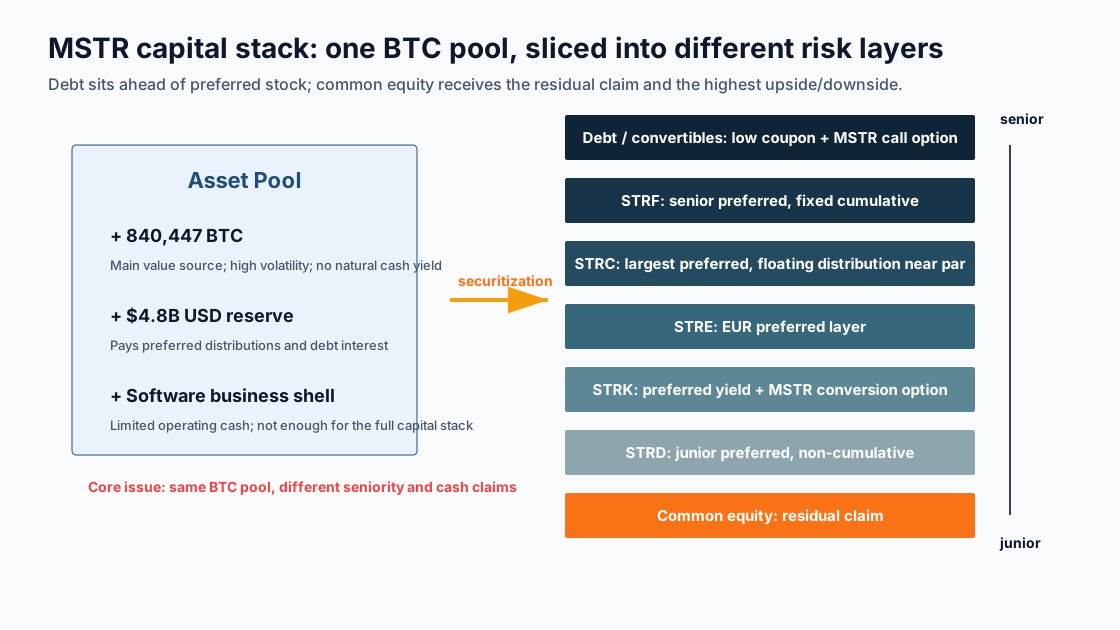
This chart uses the holdings and cash snapshot from mid-August 2026. Actual repayment and liquidation rights are still governed by each security's offering documents and applicable law.
2.1 The Asset Side Is Not Complicated, but the Cash Profile Is Very Different
| Asset | Cutoff date and scale | Meaning for common equity |
|---|---|---|
| BTC | 2026-08-16: 840,447 BTC | Main value source; high volatility; no interest or dividend |
| USD reserve | 2026-08-16: $4.8B | Pays preferred distributions and debt interest; extends refinancing runway |
| Software business | 2025 subscription-service revenue up 64.5%, total revenue up 3.0% | Provides corporate shell and limited operating cash; cannot independently carry the capital structure |
| Other assets and liabilities | Receivables, leases, deferred taxes, operating liabilities, and other items | The company's Net BPS does not cover every possible liquidation item |
The asset-side tension is clear: BTC is a high-volatility asset with no natural cash yield and an almost perpetual duration; debt interest and preferred distributions must be paid in dollars. Strategy relies on USD reserves, software operating cash, refinancing, securities issuance, or BTC sales to keep that cash chain intact.
2.2 Common Equity Owns Only the Final Residual Value
A simplified formula helps frame MSTR:
Common residual asset value = BTC market value + available cash + software business value + other assets - debt - preferred liquidation claims - other net liabilities Common net claim per share = common residual asset value / fully diluted common shares
This "net claim" is not a legal liquidation quote. Large BTC sales can move the market and may involve taxes, fees, and execution losses. The actual liquidation or redemption value of different preferred-stock classes can also be higher than nominal amount. The purpose is to avoid treating growth in total BTC holdings as common-stock value growth.
A simple example shows why the two can diverge:
Before issuance: assets are 100, common shares are 10, and net asset value per share is 10.
The company issues 100 of perpetual preferred stock and uses all proceeds to buy BTC: total assets rise to 200, common shares remain 10, and gross assets per share rise to 20.
The preferred stock claims 100 first: common net assets remain (200 - 100) / 10 = 10.
On the day of issuance, common equity has not gained value simply because total BTC doubled. Only if the future return on incremental BTC exceeds the true cost of preferred capital does residual value gradually shift to common shareholders.
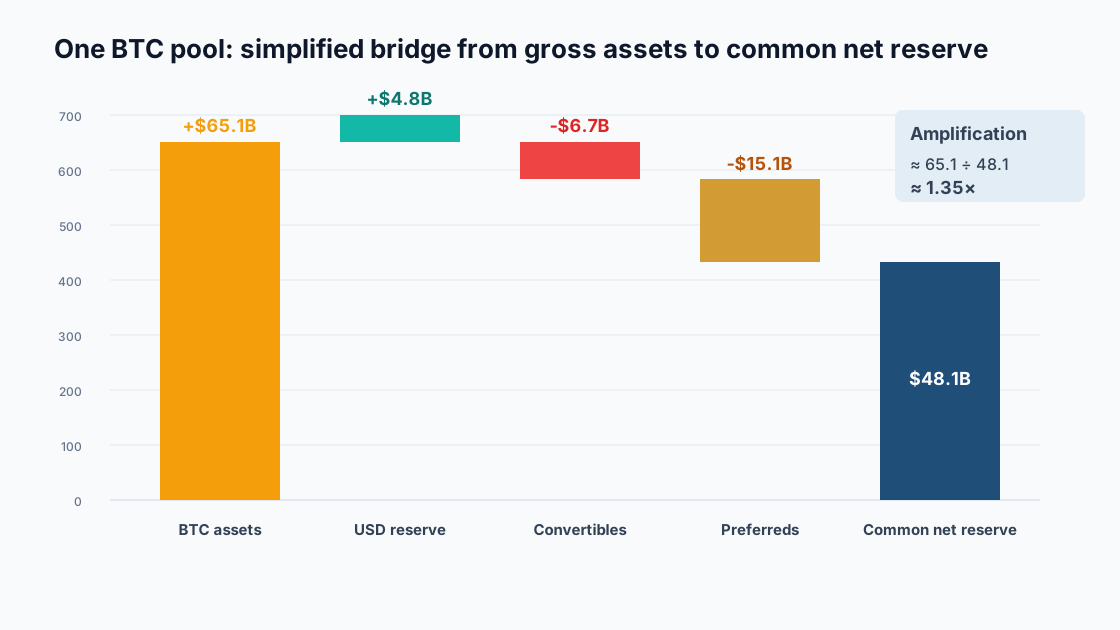
The common net reserve in the chart is an analytical tool, not a legal liquidation quote. Its main use is to separate "how much BTC the company holds" from "how much is left for common shareholders."
2.3 Economic Rights and Control Rights Are Not the Same
MSTR is publicly traded Class A common stock with one vote per share; Class B shares carry ten votes per share. Michael Saylor retains significant voting influence through the B shares. Common-stock investors therefore take BTC risk, capital-structure risk, and management capital-allocation risk at the same time. Even if a financing is mathematically accretive, per-share value still depends on whether proceeds are ultimately used to buy BTC, replenish reserves, pay distributions, repurchase securities, or retire debt.