
📚 My Bookmarks
No bookmarks yet
Use the chapter navigation to jump around this report.
Three Exchanges, Three Ways to Make Money
CME, ICE, and CBOE: Customer Access Points, Clearing Responsibilities, Normalized Earnings, and Per-Share Cash
Analysis Date: 2026-07-28 · Data Through: Market prices as of 2026-07-28, the three companies' 2020-2025 annual reports, and their latest public disclosures in 2026
Chapter 1: Executive Summary: Three Exchanges, Three Ways to Make Money
CBOE has grown the fastest over the past six years, CME returns the most operating cash directly to shareholders, while ICE deploys more cash toward acquisitions, software, and debt reduction. The three companies differ in their customers, transaction costs, clearing responsibilities, and capital allocation, and their current prices require them to deliver different levels of future growth.
1.1 Introduction: Growth, Margins, and Long-Term Returns Have Moved at Three Different Speeds
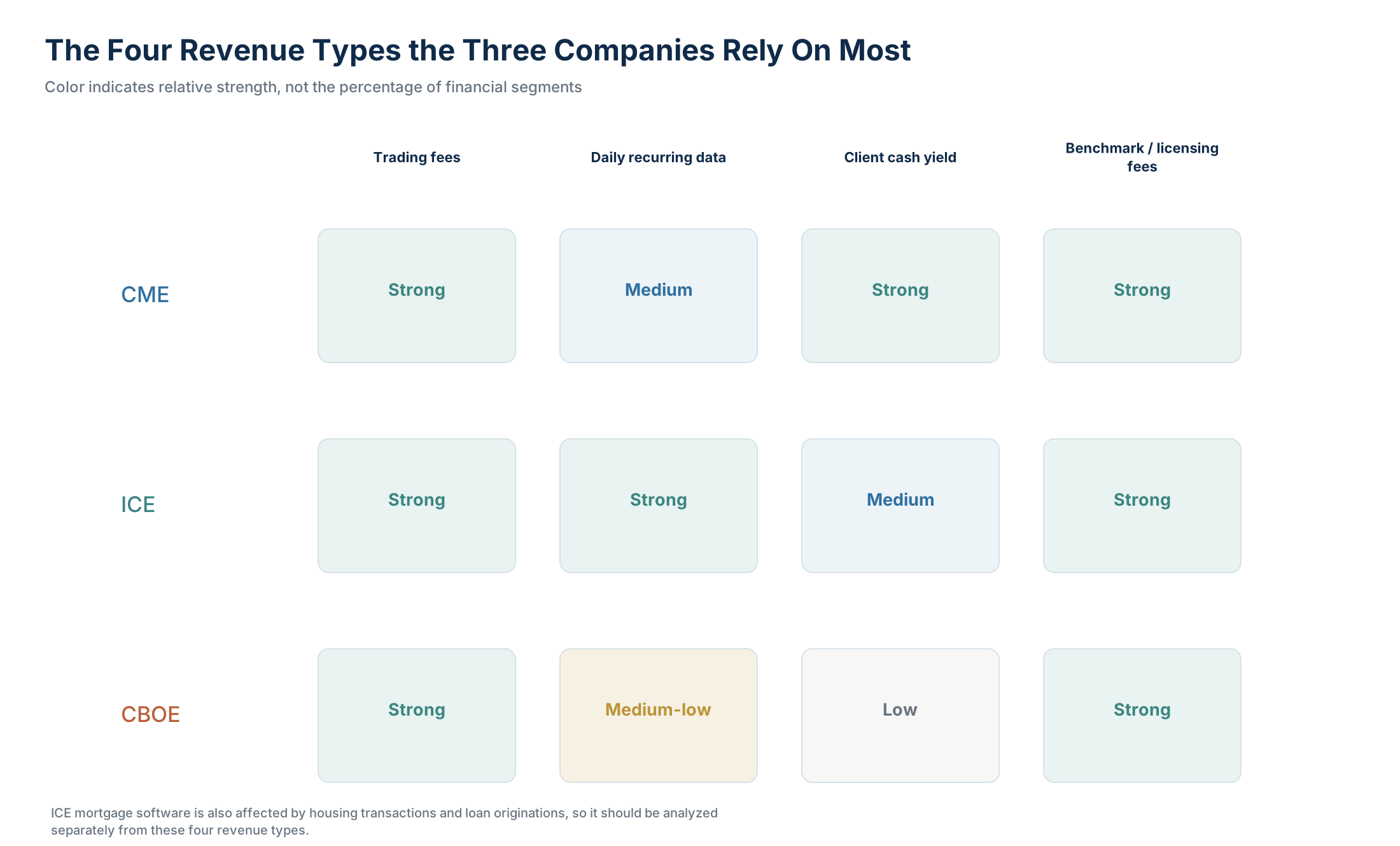
1.2 Current Prices Require the Three Companies to Deliver Different Growth Rates
| Company | Share Price | Trailing-Twelve-Month P/E | Cleaner 2025 Per-Share Metric | Share Price / Metric | 2025 Cash Dividend Yield |
|---|---|---|---|---|---|
| CME | USD 255.36 | 21.7x | Free Cash Flow of USD 11.64 | 21.9x | 4.3% |
| ICE | USD 148.73 | 21.6x | Free Cash Flow of USD 6.73 | 22.1x | 1.3% |
| CBOE | USD 288.87 | 24.7x | Adjusted EPS of USD 10.67 | 27.1x | 0.9% |
| Company | Assumed Fifth-Year Valuation | Current Cash Dividend Yield | Required Annual Growth in Per-Share Metric |
|---|---|---|---|
| CME | 22x Free Cash Flow | 4.3% | Approximately 5.7% |
| ICE | 22x Free Cash Flow | 1.3% | Approximately 8.8% |
| CBOE | 24x Adjusted EPS | 0.9% | Approximately 11.4% |
Chapter 2: Exchanges Make Money From More Than Just Trade Execution
2.1 Customers Are Buying a Lower Total Cost
Manufacturers worry about rising copper prices, while mining companies worry about falling copper prices; airlines need to control fuel costs, while refiners manage the spread between crude oil and refined products; banks and asset managers continuously adjust their interest-rate, equity-index, credit, and foreign-exchange exposures. These risks rarely match perfectly in size, tenor, or timing. Market makers and arbitrageurs bridge short-term gaps, while exchanges transform dispersed demand into standardized contracts that can be traded continuously.
A futures contract can be understood as an agreement made today to buy or sell at a specified price in the future. After an airline buys fuel futures, gains on those futures can offset part of its procurement costs even if oil prices subsequently rise. An option gives the buyer a right: after paying a fee, the buyer may buy or sell under agreed terms, but has no obligation to exercise that right. Companies use these two types of instruments to reduce earnings volatility, while funds also use them to adjust risk and express market views.
When institutions choose a trading venue, they do not compare fees alone. If a market does not have enough buyers and sellers, a large order will move the price in an unfavorable direction; this is market impact, one component of trading costs. Customers must also pay for system connectivity, trade reconciliation, and regulatory compliance, and they must post cash or securities as margin to protect against a party's default. Even if a new platform charges very low fees, its actual cost may still be higher than that of an established exchange if trading is sparse and margin cannot be shared with other positions.
2.2 An Ordinary Broker Is Not Necessarily an FCM
The term “broker” commonly used by individual investors is broad. Trading stocks and U.S.-listed options generally requires a securities-regulated broker-dealer. Futures accounts, by contrast, must be carried by a Futures Commission Merchant (FCM). An FCM may accept orders for futures and options on futures, and may also receive cash and securities that customers post as margin. A broker-dealer may carry futures customer funds in that capacity only if it separately obtains FCM registration.
The same financial group may place these two businesses in separate legal entities. Charles Schwab's stock accounts are carried by its broker-dealer entity, while its futures accounts are carried by Charles Schwab Futures and Forex LLC, an FCM. Interactive Brokers LLC and TradeStation Securities are both registered as broker-dealers and FCMs. The fact that investors see stocks, options, and futures in a single app does not mean that only one legal entity operates behind the scenes, nor does it mean that every ordinary broker is an FCM.
The futures market also frequently involves Introducing Brokers (IBs). An IB may solicit customers and provide an order-entry interface and services, but it cannot hold customer margin; the accounts and funds ultimately must be placed with the FCM that carries them. An FCM and a clearing member are also not the same concept: FCM describes the regulatory status that permits a firm to carry futures customers and their funds, while clearing member describes whether an institution can face a clearinghouse directly and assume financial responsibility for trades submitted for clearing. Large institutions often hold both statuses, while smaller FCMs or IBs may entrust clearing to a larger clearing member.
| Role | What the customer sees | Responsibility for funds and risk | Common examples |
|---|---|---|---|
| Broker-dealer | Stock, ETF, and listed-options accounts and order entry | Safeguards customer assets under securities rules; this status alone does not authorize the firm to carry futures margin | Broker-dealer entities such as Charles Schwab & Co. and Fidelity |
| IB | Solicits futures customers and provides an interface and services | Does not hold customer margin; transfers the account to an FCM | Independent futures brokers and some front-end platforms |
| FCM | Opens futures accounts, receives orders, and manages customer margin | Responsible for segregating customer funds, conducting risk checks, and issuing margin calls | Interactive Brokers, Schwab Futures and Forex, TradeStation Securities |
| Clearing member | Submits executed trades directly to the clearinghouse | Assumes performance and default obligations to the clearinghouse and contributes margin and default-fund resources | ABN AMRO Clearing, J.P. Morgan Securities, Marex, R.J. O'Brien, and others |
| Market maker | Continuously quotes bid and ask prices | Bears inventory, price-gap, hedging-error, and capital-usage risk | Proprietary trading firms and bank market-making desks |
| Central clearinghouse | Becomes the seller to the buyer and the buyer to the seller after a trade | Settles gains and losses daily, collects margin, and manages default losses | CME Clearing, ICE Clear, OCC |
The roles in this table may overlap. A large bank may simultaneously be a broker-dealer, FCM, clearing member, and market maker; an exchange group may own both a trading venue and a clearinghouse. When analyzing a company, investors must examine the specific legal entities and stages of the business rather than looking only at the group brand.
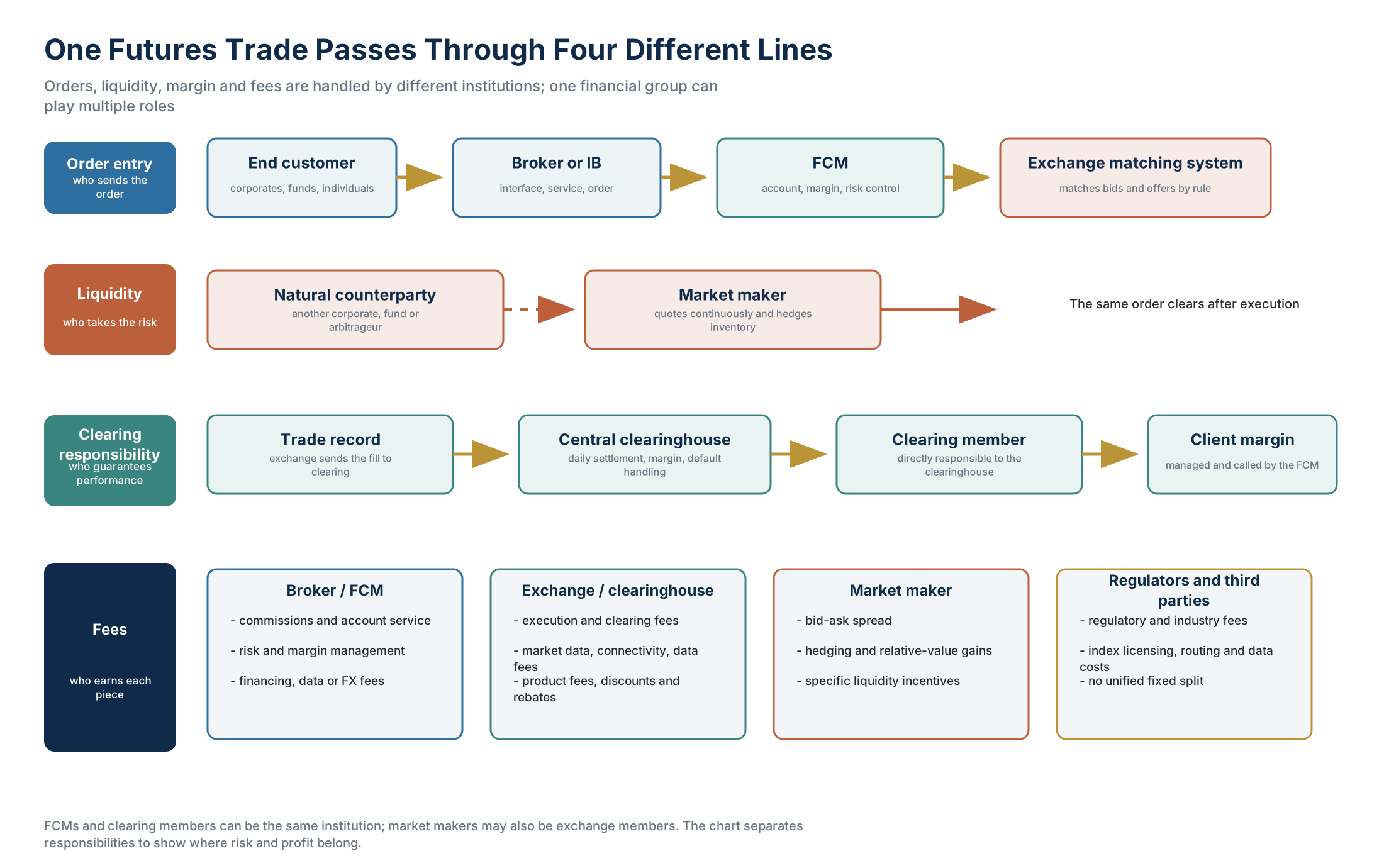
Figure 2 | Orders, liquidity, clearing responsibility, and fees are handled by different institutions; the same financial institution may perform multiple roles.
2.3 A Trade Passes Through Order Entry, Liquidity, and Clearing
Suppose an air-conditioner manufacturer is concerned that copper prices will rise in three months. It first submits an order to buy copper futures through a broker or trading application. The FCM checks the account's permissions, available margin, and risk limits before routing the order to the exchange. The exchange's matching system searches for a seller according to price, time, and other rules; the seller may be a copper mining company, a fund, an arbitrageur, or a market maker temporarily taking on the risk.
Once the trade has been matched, the buyer and seller generally no longer bear each other's credit risk directly. Through a legal process of novation, the clearinghouse becomes the seller to the buyer and the buyer to the seller. It recalculates gains and losses each day using the settlement price: when copper prices rise, the air-conditioner manufacturer's futures account receives a gain and the seller's account pays the same amount; the reverse occurs when prices fall. The FCM collects margin from customers, while the clearing member posts the collateral required by the clearinghouse into the clearing system. When a customer's margin is insufficient, the FCM will demand additional funds or reduce the customer's positions.
If a customer defaults, the loss does not first fall on an ordinary customer on the other side of the trade. The FCM and clearing member must manage the customer's positions and assume the relevant responsibilities in accordance with the rules. The clearinghouse then follows its default waterfall, using the defaulter's resources, members' default-fund contributions, and other protective layers. The exchange matches trades, while the clearinghouse turns those trades into enforceable contracts; when both functions are owned by the same group, that group has deeper control over position, margin, and risk data.
CME's principal futures contracts are cleared through CME Clearing, while ICE's energy futures enter clearinghouses owned by ICE. U.S.-listed equity options, by contrast, are all cleared through OCC, regardless of whether the order is executed on CBOE, Nasdaq, or another options exchange. CBOE therefore owns products such as SPX and VIX and operates trading venues, but unlike CME, it does not have an exclusive clearing relationship for its core options. Ordinary equity options can also be opened on one exchange and closed on another, making it easier for brokers to route the next order to a different venue.
2.4 Market Makers Bridge Timing Gaps but Do Not Bear Responsibility for Defaults Across the Entire Market
Natural buyers and natural sellers rarely appear in the same second, and they rarely need exactly the same quantity and tenor. Market makers simultaneously quote prices at which they are willing to buy and prices at which they are willing to sell. A customer seeking immediate execution can trade with a market maker, which then hedges the risk with another futures contract, the underlying cash instrument, an option, or a related asset. A market maker bridges the gap created by buyers and sellers arriving at different times.
Market makers earn primarily from the bid-ask spread, as well as from hedging and relative-value trading gains. They can also lose money: when the market suddenly gaps, inventory cannot be hedged in time; when their quotes face better-informed customers, the price may immediately move against them after a trade; and when market stress rises, their margin and financing requirements also increase. Market makers bear short-term market risk, while clearinghouses and clearing members manage counterparty defaults. These two categories of responsibility should not be conflated.
Exchanges establish market-making obligations and incentives for some products. Market makers that meet requirements for continuous quoting, bid-ask spreads, quote size, and time in the market may receive fee discounts, liquidity rebates, or incentives for new products. Maker-taker pricing is common in stocks and ordinary options: a party that posts an order in advance and adds liquidity may receive a rebate, while a party that executes immediately and consumes liquidity pays a fee. Futures markets also offer volume discounts and market-making programs, but not every contract follows the same maker-taker rules.
The fees paid by customers are not divided evenly in fixed proportions among the exchange, FCM, and market maker. Futures customers typically see FCM commissions, exchange execution fees, clearing fees, and regulatory fees, and may also incur market data, software, financing, or foreign-exchange costs. Exchanges and clearinghouses charge according to their fee schedules, while FCMs retain their own brokerage, risk-management, and financing revenue; market makers generally do not receive a fixed share of customer commissions, but instead earn the bid-ask spread and specific incentives provided by the exchange. Payment for order flow that retail brokers receive from wholesale market makers is a separate arrangement and should not be confused with exchange rebates.
2.5 New Contracts Are Built Jointly by Exchanges, Market Makers, FCMs, and Real Customers
An exchange can design contract specifications, expiration dates, trading hours, and settlement methods, but it cannot create liquidity by itself. Market makers must be willing to quote continuously; FCMs and brokers must enable customers to open accounts, post margin, and route orders; the clearinghouse must establish margin and default rules; and commercial enterprises and funds must have recurring, genuine risks to manage.
During the initial launch of a new contract, exchanges often use fee discounts and market-making incentives to establish two-sided quotes. If the market consists only of short-term trading attracted by subsidies, with no corporate hedging, fund positions, or demand to roll positions between contract months, it will disappear once the incentives end. An exchange's product innovation is more like a collaborative undertaking: the exchange standardizes the risk, market makers enable customers to trade at any time, FCMs provide account and funding channels, the clearinghouse ensures that contracts can be performed, and end users determine whether the market deserves to exist over the long term.
Orders can be rerouted easily; prices already embedded in contracts, margin already posted into the clearing system, and data that institutions use every day are harder to move. CME controls its own futures clearing system, giving customer positions and margin greater stickiness. ICE's energy prices are used in physical trade, while its financial data is embedded in the daily workflows of banks and funds. CBOE excels at designing index and volatility products, but because core U.S. options are all cleared by OCC, CBOE does not directly control this margin pool.
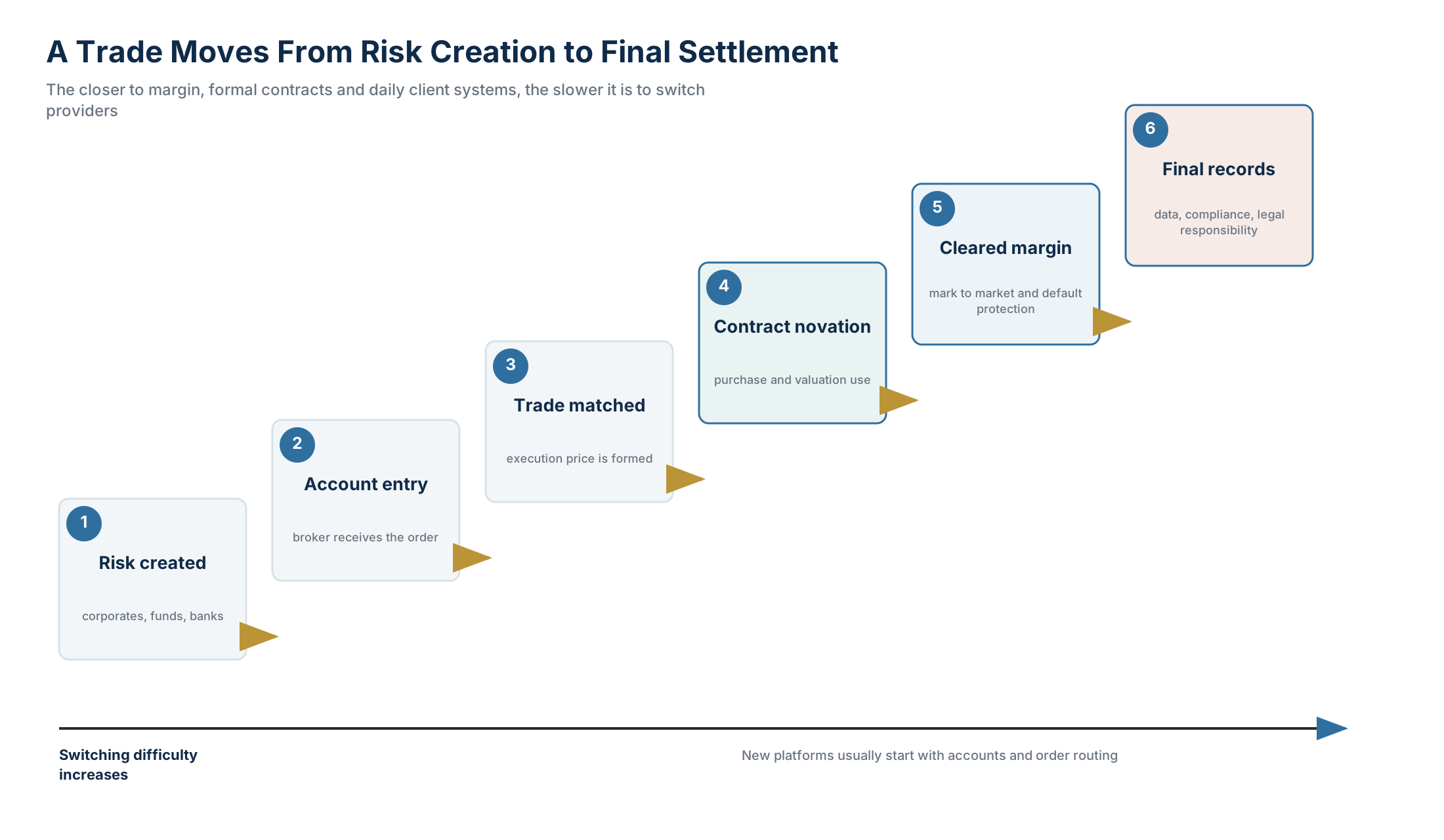
Figure 3 | Customers can change their order-entry channel relatively easily, but moving margin, amending formal contracts, and changing the data systems used in daily operations take longer.
2.6 Exchanges Charge Fees, While Market Makers Earn the Bid-Ask Spread
Exchanges generally do not put their own money on the buy or sell side, nor do they capture the entire bid-ask spread shown on the screen as profit. Market makers continuously quote bids and asks and bear short-term inventory risk, so the bid-ask spread primarily compensates them. Exchanges provide matching, rules, oversight, and clearing, then charge one or both sides according to the number of contracts, number of shares traded, or notional value.
Stocks and ordinary options often use “fee-and-rebate” pricing. An exchange may charge the party that executes immediately, then return part of that fee to the party that posted the order in advance and provided liquidity. What the company retains is the net amount after deducting rebates, routing, clearing, licensing, and regulatory costs. Rebates encourage market makers to keep better quotes and more orders on the exchange; they are distinct from the income market makers earn from the bid-ask spread.
According to CBOE's 2025 financial statements, the company received $4.714 billion in gross revenue, then paid $1.710 billion in liquidity rebates, $80 million in routing and clearing fees, $239 million in regulatory-related costs, and $256 million in index licensing and other costs of revenue. After deducting these items, the company retained $2.429 billion in net revenue. Cash equities and ordinary options may generate very high trading volume, but if an exchange must return a large portion of its fees to liquidity providers, the amount ultimately retained for shareholders will be much lower. Data Vantage presents the opposite picture: of its $636 million in gross revenue in 2025, approximately $623 million became net revenue, indicating that very little of what customers paid for data and connectivity had to be rebated to order-flow channels.
The greater the disagreement over future prices, the more frequently customers typically adjust their positions, increasing transaction revenue. Disagreement alone is not enough; customers and market makers must also have enough capital to absorb risk. A market crash may cause futures and options volume to rise rapidly because many contracts are charged per contract, so a decline in the underlying price does not automatically reduce the fee per contract; however, if subsequent margin calls force customers to reduce their positions, open interest and future roll revenue may instead decline. A favorable operating environment for exchanges is one in which customers hold widely divergent views while still having sufficient capital to carry positions into the next day.
After a customer buys a contract, an outstanding contract remains in the market until the position is closed; the industry calls this open interest. Before a contract expires, customers often close the old contract and move into a later-dated contract, an action known as rolling the position. More open interest generally leads to more future rolls, margin, and data usage; trading volume indicates how active the market is on a given day, while open interest is a better measure of the business that remains on the platform.
The cash and securities that customers post for their positions are collectively called margin or collateral. Exchanges and the clearing system can earn revenue from certain cash balances and related services, and this revenue varies with short-term interest rates and customer balances. Even if market activity cools, related revenue may remain strong as long as short-term rates remain high and customer funds stay in the system.
Exchanges also sell real-time market data, daily settlement prices, system connectivity, index licenses, and risk-management tools. Once banks and funds integrate this data into valuation, accounting, and risk-control systems, they continue paying even on days when they do not trade. Changing data providers often requires software modifications, renewed testing, and compliance approval, so this revenue is generally the most stable.
One successful contract can generate four sources of business: the initial trade, subsequent rolls, margin-related revenue, and data subscriptions. A market trend can generate only the first; revenue can continue for years only when customers are willing to hold positions over time and integrate the prices and data into their daily systems.
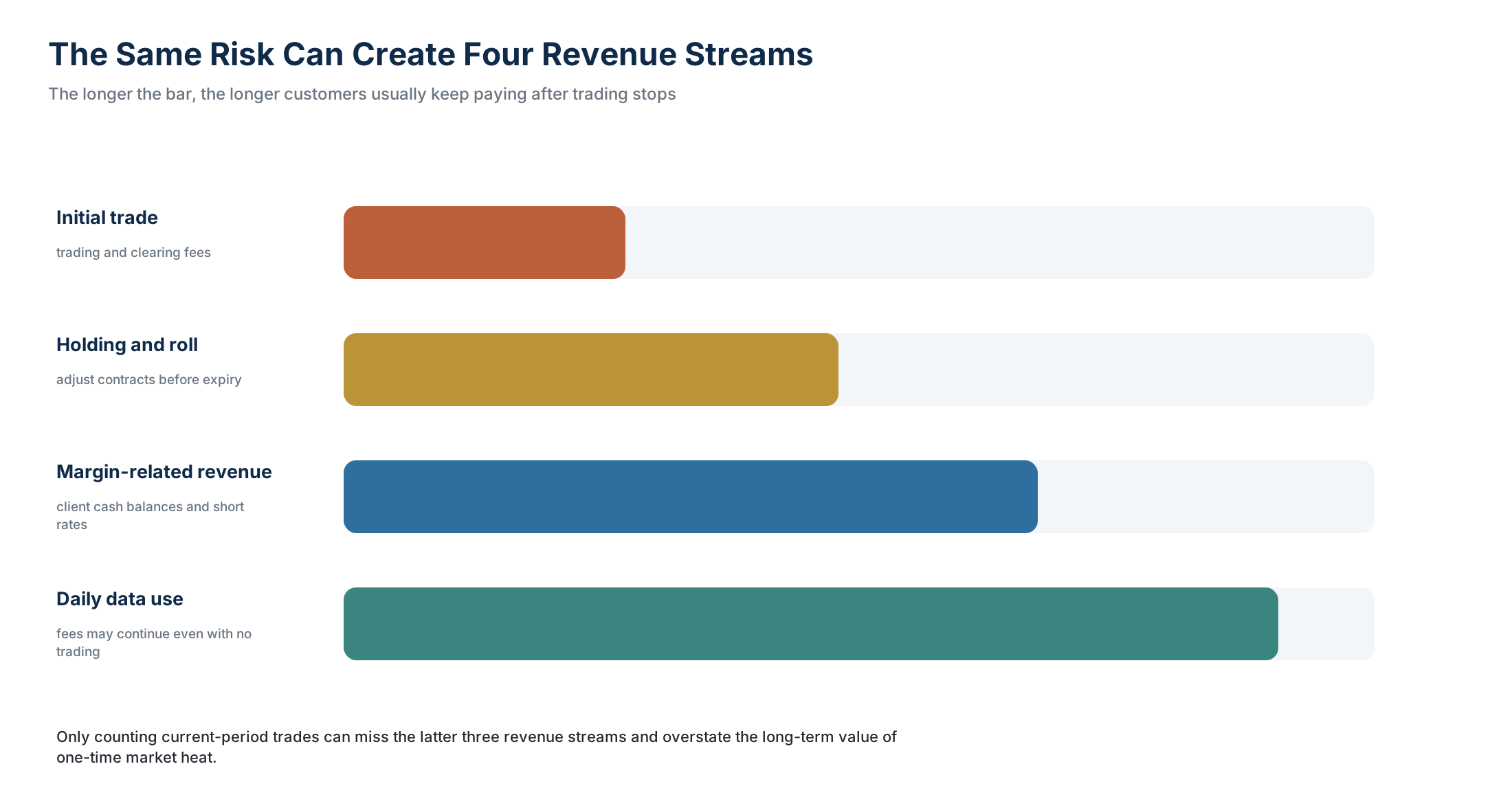
Figure 4 | The same risk can generate four sources of revenue—trading, rolls, margin, and data—each with a different duration.