
📚 My Bookmarks
No bookmarks yet
Use the chapter navigation to jump around this report.
Robinhood: From Consumer Trading Gateway to Callable Financial Account
Robinhood (NASDAQ: HOOD) In-Depth Equity Research Report
Analysis date: 2026-08-11 · Data through: Financials through 2026Q2; product, regulatory, and onchain adoption data through 2026-08-10; valuation anchored to the 2026-07-29 closing price of $89.84
Robinhood has proven that low-barrier products can acquire young customers, and that a single account can support trading, cash, borrowing, retirement, credit card, advisory, and crypto needs. The question now is whether those relationships can endure trading and interest-rate cycles and continue increasing cash per share after expansion into agents, trading venues, and onchain finance.
Chapter 1: Executive Summary: Robinhood's Present Value and Long-Term Frontier
Robinhood is no longer an app that acquires customers solely through commission-free trading, nor is it yet a mature global financial infrastructure system. The most accurate definition today is a financial platform centered on young consumers' accounts, monetizing through multi-product distribution and account balances, and beginning to extend into trading venues and callable financial networks.
The company's evolution over the past thirteen years can be condensed into one continuous path: first, use commission-free trading, fractional shares, and mobile access to lower the account-opening barrier and acquire customers who have completed identity verification and linked a bank account; next, use options, event contracts, cash, margin, and securities lending to raise revenue per customer; then extend relationships through Gold, retirement, advisory, credit card, and Banking; and finally, use Bitstamp, Rothera, Agentic Trading, Stock Tokens, and Robinhood Chain to move from financial-product distributor toward selected parts of market infrastructure and an asset-rights network.
This path explains Robinhood's upside and why it increasingly resembles something other than an asset-light internet company. The more products it offers, the more likely it is to become the customer's primary financial account. Yet margin, credit cards, clearing, deposits, token issuance, and continuous onchain services also bring credit losses, liquidity demands, regulatory capital, cybersecurity, and compensation liability into the calculation of shareholder returns.
Robinhood has proven consumer-finance distribution and profitability in favorable conditions, is proving the primary-account relationship, and has not yet proven an external financial network. Using the July 29, 2026 closing price of $89.84 as this report's valuation anchor, the current price offers limited room for error: investors are paying not only for the existing brokerage profits, but also in advance for success as a primary account and for part of the network optionality.
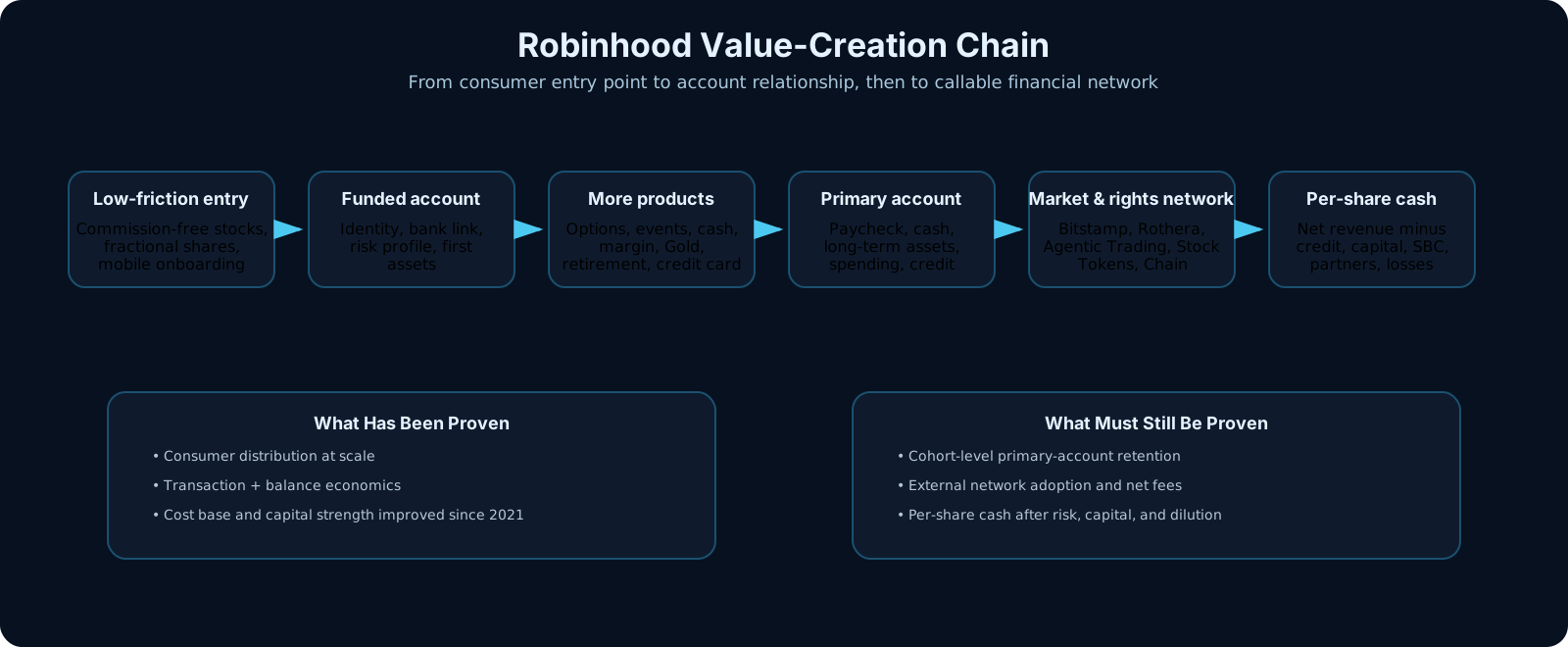
1.1 What Has Already Been Proven
First, Robinhood has achieved consumer distribution at scale. In 2026Q2, the company had 28.4 million funded customers, $369.0 billion in platform assets, and approximately 4.8 million Gold subscribers. Event contracts became a $156 million quarterly-revenue business in a short time, while Gold, retirement, and credit card products also expanded rapidly. These results show that the company can place a new product directly in front of tens of millions of accounts that have already completed onboarding, funding, and risk assessment, materially shortening the cold-start period for new products.
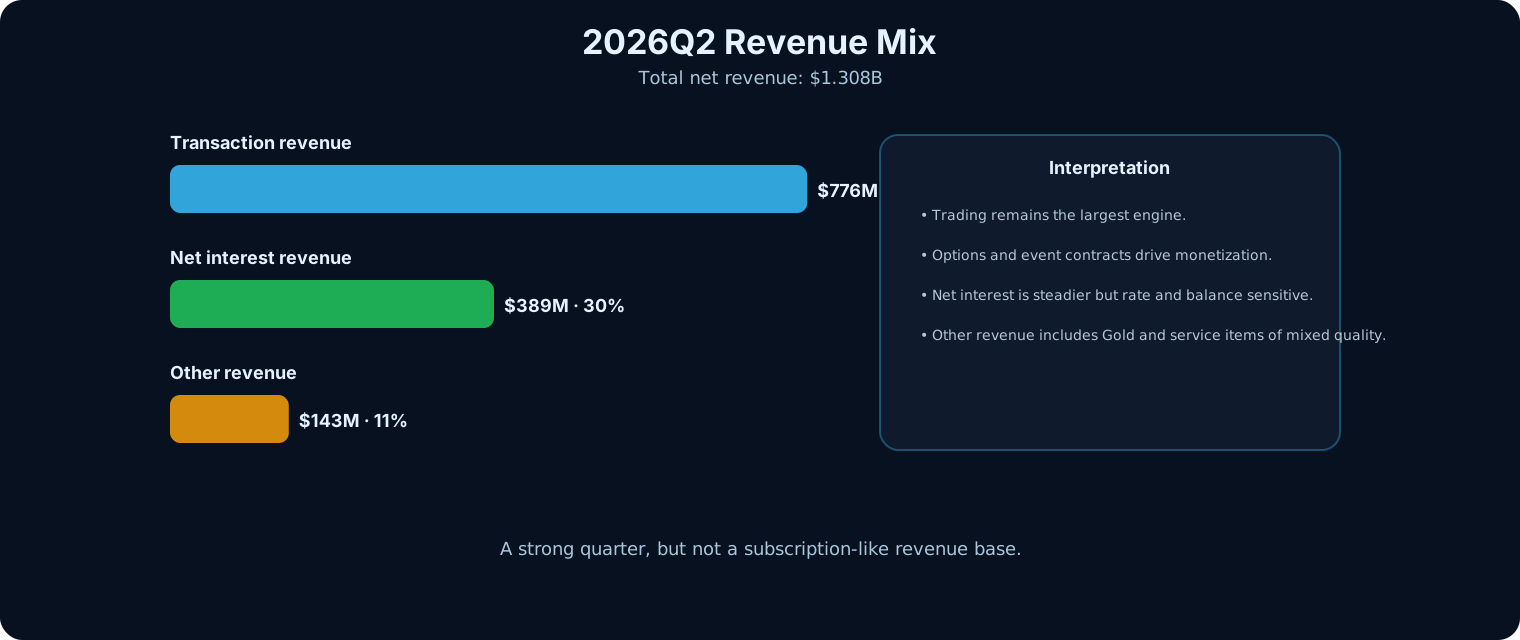
Second, current profit does not come only from cryptocurrency. In 2026Q2, the company generated $1.308 billion in revenue, of which transaction-based revenue represented 59%, net interest revenue 30%, and other revenue 11%; Adjusted EBITDA was $741 million. Crypto revenue fell 38% year over year while total company revenue still grew 32%, demonstrating that options, event contracts, equities, cash, and margin now support profit together. Crypto assets also fell from approximately 20.2% of platform assets in 2024Q1 to approximately 7.1% in 2026Q2. The expansion in platform assets over the past two years has come primarily from customer relationships outside crypto.
Third, the company's cost base and capital capacity are materially stronger than in 2021. Post-boom workforce reductions and spending discipline have made it easier for recovering trading activity and new-product growth to convert into profit; the company also has stronger corporate cash, credit facilities, and financing capacity. Robinhood is no longer a high-fixed-cost trading app that can survive only during a retail-trading boom.
1.2 What Is Taking Shape but Is Not Yet Complete
Robinhood is moving from a trading account toward a primary account. Gold bundles cash yield, margin, retirement matching, and credit card eligibility; retirement assets have reached approximately $34.5 billion; Banking has more than $3 billion in deposits, with approximately 40% of customers setting up direct deposit; Gold Card has more than 1 million users; and managed investing and the advisor network are beginning to serve customers with more complex assets. Together, they point to a more durable business model: customers do not merely place occasional trades, but keep their paychecks, cash, long-term assets, spending, and credit relationships on the same platform.
However, existing disclosures still cannot fully answer the most important question: when the same customer expands from one product to three or five, how exactly do net deposits, retention, normalized revenue, and servicing costs change? Rapid growth in Gold and retirement proves that distribution works, but by itself it does not prove subsidy payback or customer lifetime value beyond three years. Credit card and margin growth produce revenue, but have also increased credit-loss provisions and capital requirements.
1.3 What Remains Optionality
Agentic Trading, Rothera, and Robinhood Chain have genuine strategic significance, but not enough evidence yet to serve as the foundation of current earnings.
Agentic Trading allows third-party models to read account context and execute trades within a segregated pool of funds. It expands Robinhood's external distribution: even if customers eventually express their needs through ChatGPT, Claude, or another interface, the company may preserve assets, orders, and cross-selling as long as the account, permissions, and execution remain at Robinhood. The cost is that customer-intent data and default routing begin to occur outside the company, while agents continually compare cash yields, borrowing costs, and execution quality, compressing unit economics that previously benefited from informational inertia. As of the data date, nearly 100,000 Agentic accounts held more than $100 million in aggregate AUC, demonstrating real adoption, though the average account remains a small-scale experiment.
Rothera moves Robinhood from prediction-market distributor toward exchange and clearing functions. The true network evidence is not Robinhood App volume, but whether third-party FCMs, independent market makers, external open interest, and collateral enter on a sustained basis. With only parent-company order flow, Rothera remains an extension of an internal distribution channel; only durable third-party participation can turn it into independent market infrastructure.
Robinhood Chain has proven that the company can quickly organize users, stablecoins, DEXs, and liquidity, but it has not shown that onchain activity can reliably become shareholder profit. Approximately $3.6 million of chain-level revenue in the first month annualizes mechanically to approximately $43.2 million; an external estimate that adds assumptions for USDG and Lighter reaches approximately $54.8 million annualized, only about 1.05% of annualized second-quarter company revenue, and it includes the annualization of launch-month activity and undisclosed revenue shares. TVL, trading volume, protocol fees, and active addresses cannot directly substitute for Robinhood's recognizable net revenue.
Stock Tokens further expose the distinction between a product and infrastructure. Neither of Robinhood's two current types of Stock Tokens makes customers registered shareholders of the underlying company. Price tracking, onchain balances, dividends, and stock splits are only part of an asset's state; merger consideration, spin-offs, redemptions, bankruptcy seniority, exception recovery, and compensation determine whether it can become a securities-rights system on which institutions are willing to rely over the long term.
1.4 Current Financial Quality and Valuation Requirements
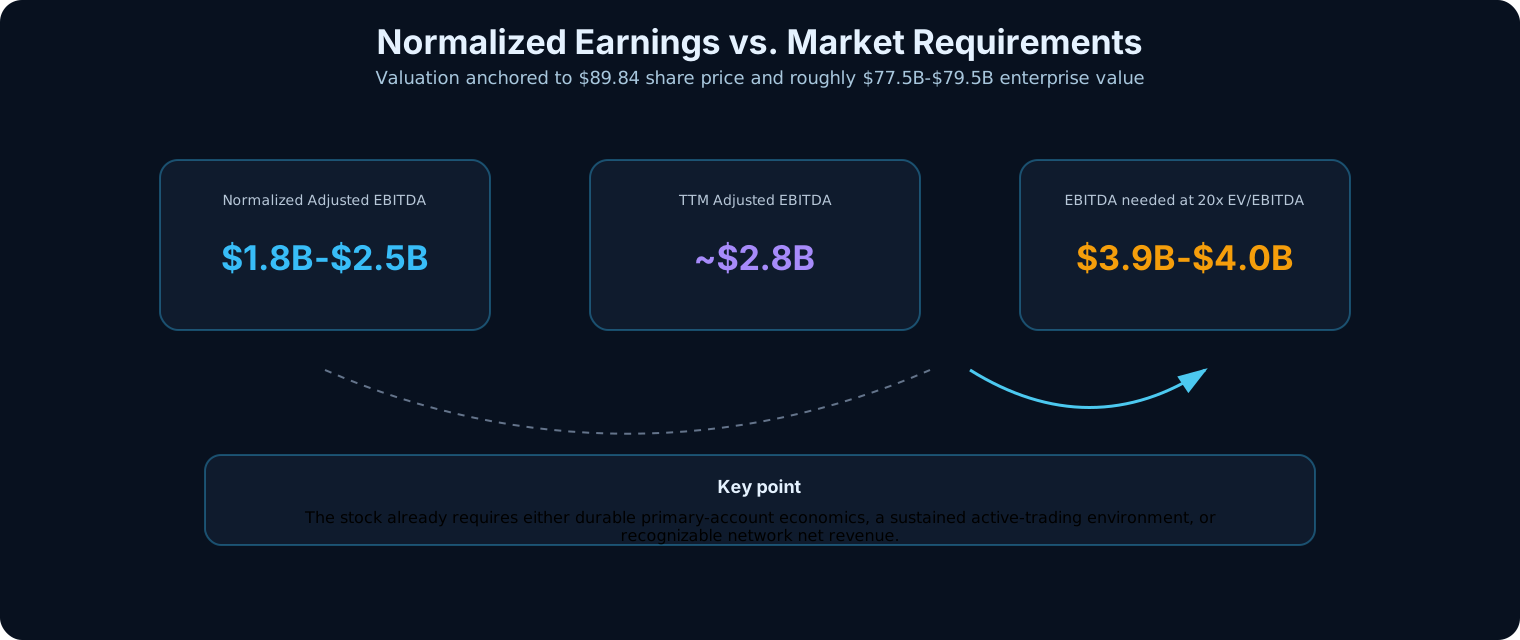
Robinhood's current earnings are strong, but they remain situated in an environment where trading, margin, and event contracts are all active. Rebuilding the economics using mid-cycle volumes and rates, cash and margin balances, recurring Gold revenue, credit losses, SBC, and new-business costs produces estimated normalized revenue of approximately $4.1 billion to $4.8 billion, normalized Adjusted EBITDA of approximately $1.8 billion to $2.5 billion, and normalized diluted EPS of approximately $1.2 to $1.7.
Using the $89.84 reference price and an enterprise value of approximately $77.5 billion to $79.5 billion, normalized EV/EBITDA is approximately 31x to 44x and normalized P/E approximately 53x to 75x. If the market assigns only 20x EV/EBITDA three years from now, the company would need approximately $3.9 billion to $4.0 billion in EBITDA to sustain its current enterprise value—nearly twice the midpoint of normalized EBITDA. This means that at least one of the following must occur: the primary-account relationship must deliver materially, or the active trading environment must persist for the long term. To generate still higher returns, network optionality would also have to begin producing recognizable net revenue.
1.5 The Three Evidence Sets That Truly Matter
The first is account evidence. When trading slows, do net deposits, Gold, retirement assets, direct deposit, and managed assets continue to grow? As the same cohort adopts more products, can the subsidies be recovered, and do servicing costs and attrition decline?
The second is network evidence. Do agents bring meaningful assets rather than small trials? Does Rothera attract external orders and clearing? Does Chain gain third-party issuers, applications, market-making capital, and recognizable net revenue? Do Stock Tokens progress from price products toward complete rights and continuous performance?
The third is shareholder evidence. After deducting SBC, credit losses, regulatory capital, customer incentives, acquisitions, and convertible debt, does cash per share continue to rise? Growth in total revenue, platform assets, TVL, or transaction count cannot replace this final test.
1.6 Final Judgment
Robinhood's quality as a company is now materially better than the old label of a “high-growth broker” suggests. It has a scarce gateway to young customers, rapid product distribution, deepening account relationships, and stronger cost discipline, as well as an opportunity to become an important connection layer between regulated consumer accounts and open finance.
But its moat remains under construction. Commission-free trading, interfaces, cash yields, a particular options feature, or a low-cost chain can all be copied. What is genuinely hard to copy is customers entrusting their paychecks, retirement, taxes, credit, and long-term assets to one account, and the company's ability to honor rights and bear responsibility in complex transactions and failures. The former requires years of retention; the latter requires licenses, operations, and capital.
Robinhood is therefore best understood today as a financial platform that has proven efficient distribution, is upgrading into a primary account, and possesses high-upside network optionality. The business merits long-term tracking, but the valuation requires investors to pay in advance for several outcomes that remain incompletely proven.
Chapter 2: What Kind of Company Is Robinhood? — From Commission-Free Gateway to Consumer Financial Account
Robinhood's history is not a string of product launch dates. Each expansion has repaired weaknesses exposed by the prior stage while bringing new revenue and new responsibilities into the company. Understanding this path is essential to judging whether Agent, Rothera, and Chain are natural extensions or capital-consuming departures from the core business.
2.1 2013–2019: Free Trading Acquires the First Accounts
When Robinhood was founded, traditional brokers already offered research, retirement, advisory, and professional tools, but websites were complex, account opening was cumbersome, and per-trade commissions made investing a few hundred dollars uneconomic. Robinhood put equity trading on a phone, reduced explicit commissions to zero, and later used fractional shares to lower the entry barrier for high-priced stocks. It did not invent the stock market; it changed the cost, frequency, and psychological barrier for young customers entering that market.
Free did not eliminate fees. The company earned revenue from order-execution arrangements, customer cash, and securities lending, using the future economics of the account to subsidize today's zero-commission entry point. The model acquired customers effectively but left three long-running controversies: who receives the orders for execution, whether a simple interface encourages excessive trading, and whether risk disclosures keep pace with product complexity. Options, crypto, and event contracts would later face the same questions.
After major U.S. brokers broadly eliminated equity commissions in 2019, the price innovation became an industry standard. Robinhood lost its unique free-trading advantage, but retained a more important asset: a cohort of young customers who had completed identity verification, linked a bank account, learned the mobile interface, and were willing to try new financial products. Competition shifted from “who is free” to “who can deepen the account relationship.”
2.2 2020–2021: The Trading Boom Amplifies Revenue and Exposes Capital Constraints
The pandemic, fiscal stimulus, time at home, and social media jointly increased retail trading, with rapid growth in meme stocks, options, and cryptocurrency. Robinhood's users, revenue, and market influence rose together, and the business became highly dependent on a handful of popular assets and active traders. The market extrapolated that trading boom into long-term growth just as the company faced extreme strain with immature systems, customer service, and risk management.
In early 2021, sharp volatility in GameStop and other stocks caused NSCC to raise brokers' clearing-deposit requirements. Robinhood had to raise capital quickly and restricted purchases of certain stocks. Customers saw the buy button disabled in the app; behind the scenes, clearing collateral and corporate capital were insufficient to support continued order growth. This episode left the company with an expensive but important lesson: owning the customer and the order is not the same as controlling the entire transaction; the more active trading becomes, the greater the clearing, liquidity, and capital requirements can be.
The same period also exposed revenue concentration. Popular options and a handful of crypto assets contributed heavily, and fading customer interest flowed quickly through to revenue. At the IPO, Robinhood looked more like a high-growth trading app, with valuation built on continuation of the trading boom; the following two years proved that this portion of profit had to be assessed over a full cycle.
2.3 2022–2023: Fix Costs First, Then Shift the Operating Goal from Clicks to Assets
Declining risk assets, crypto-industry failures, and lower retail volume pushed Robinhood into its first contraction as a public company. The company reduced headcount and fixed costs, curtailed some projects, and shifted its operating focus from new users and trading clicks to net deposits, customer assets, and account balances. Higher interest rates also made cash, margin, and securities lending more important revenue sources.
This restructuring changed the earnings sensitivity that followed. Had fixed costs remained scaled for the 2021 boom, new-product revenue from 2024–2026 could easily have been absorbed by organizational spending. With a lower cost base, recovering trading and new-product growth converted into operating profit more readily. The company also identified a more stable variable than trade count: as long as customers keep cash and securities in their accounts, the platform can earn continuously from cash, lending, and securities-lending relationships.
The 2022–2023 trough therefore drove two simultaneous turns: financially, lower costs; commercially, a shift from “more clicks” to “more assets retained in the account.” Today's high earnings reflect both the trading environment and these two structural improvements.
2.4 2024–2026: Competing for the Primary Account and Attempting to Control More of the Market
Gold, retirement accounts, cash management, credit cards, managed investing, and Banking gradually expanded. Robinhood acquired credit card capabilities through X1, connected to independent-advisor workflows through TradePMR, and gained institutional crypto customers, licenses, and trading infrastructure through Bitstamp. The company began competing for paychecks, long-term savings, and everyday spending, no longer content to have customers open the app occasionally to buy a stock.
These products share one feature: they reuse the existing account. After one identity verification and bank connection, Robinhood can sell the same customer a membership, retirement matching, margin, a credit card, and managed investing without paying a full customer-acquisition cost for each product. The more products a customer uses, the harder it becomes to move all the assets, tax records, daily funds, and credit relationships together.
At the same time, the company began to move from “distributing products in markets built by others” to “operating part of the market infrastructure.” Bitstamp adds professional crypto capability, Rothera attempts to extend event-contract distribution into exchange and clearing, Robinhood Chain seeks to place accounts, stablecoins, Stock Tokens, trading, and lending on one network, and Agentic Trading makes third-party software the front end.
This expansion addresses the company's past dependence on external trading venues, clearing, crypto liquidity, and a single app interface. It also makes the company heavier: retirement matches consume cash upfront; credit cards bring rewards, fraud, and charge-offs; margin requires liquidity and risk capital; and Chain and Stock Tokens must handle cybersecurity, corporate actions, and legal rights. The front end remains simple, but the back end now spans securities, derivatives, credit, payments, digital assets, and market infrastructure.
2.5 Three Lessons from the Company's History
First, Robinhood always lowers the barrier to use before moving into deeper responsibility. Commission-free trading first captured orders; cash and margin then captured balances; Gold and retirement captured long-term relationships; and Rothera and Chain now seek trading venues, asset interfaces, and portions of the settlement layer. Each step farther back in the chain may raise revenue per customer, but it also increases regulatory capital and potential losses from failures.
Second, new products primarily reuse customer distribution, and the moat comes from combined relationships. Equity commissions, options interfaces, cash yields, and chain technology can all be copied; tens of millions of funded customers, payroll and retirement assets, multi-product records, and long-term trust are harder to rebuild quickly. Robinhood's advantage depends on whether customers entrust it with a second, third, and even fifth financial relationship.
Third, the revenue engines have broadened, but cyclicality has not disappeared. Transaction revenue varies with risk appetite, balance revenue changes with interest rates and borrowing demand, credit businesses reveal losses with a lag after growth, and network businesses require years to build external adoption. A larger number of products can diversify single-asset risk, but cannot ensure that every revenue stream remains stable during the same market downturn.
Robinhood is a company that has proven consumer distribution, is proving a primary account, and has not yet proven an external financial network. Agent, Rothera, and Chain are not abrupt new stories; they are the next step in the company's continued movement from account gateway toward balances, relationships, venues, and rights.