
I do not drink much coffee, but every time I walk past a Starbucks I feel a strange sense of familiarity. When meeting friends, I default to suggesting Starbucks. No thinking, no choosing, just walk in.
Late last year, I was walking down the street and noticed a few Starbucks locations had closed. Not the "under renovation" kind of closed — actually gone.
Around that time I happened to be reading a few books by Howard Schultz. Schultz is the founder of Starbucks, and his books tell the story of how he grew the company from a single store in Seattle to over 40,000 worldwide. Every page radiates passion, idealism, and the vision of the "third place."
But the books describe a different era.
Put the book down, step outside, and what you see is shuttered storefronts, shorter lines, and a brand in retreat. Last year alone, Starbucks closed 627 stores in the U.S.
That contrast made me want to understand what happened. So my team and I started digging into Starbucks seriously. 👉 Full SBUX Report
Let's start with something everyone noticed.
In August 2024, Starbucks announced it was poaching Brian Niccol from Chipotle to be its new CEO. The day the news broke, Starbucks stock surged 24% — its biggest single-day gain since the 1992 IPO. The market priced that one name at roughly $20 billion in a single day.
What makes Niccol worth that price? During his six and a half years at Chipotle, he delivered a 770% total shareholder return — versus 99% for the S&P 500 over the same period. Restaurant-level margins went from 19% to nearly 29%. Average unit volume broke through $3 million from $2 million.
His method was intuitive: simplify the menu to seven or eight core categories. Accelerate digital by adding a dedicated prep line for online orders. Chipotle's production model is an assembly line — customers walk along the counter while employees add ingredients in sequence. Add a second line, and throughput nearly doubles.
So the first thing he did at Starbucks followed the same playbook. A four-minute service promise. Menu trimmed by 30%. Handwritten names back on cups. The direction was clear — "back to Starbucks."
But there is a problem he never faced at Chipotle.
A burrito is assembly. Coffee is craft.
A single latte requires extraction, milk steaming, pouring, and customization — an average of 3.5 modifications per order. Oat milk, extra shot, no sugar, different cup size. Multiply it out, and Starbucks has over 170,000 possible drink combinations.
This is not something a second prep line can solve.
And Chipotle handed Niccol a clean weapon. $1.5 billion in net cash, no long-term debt, a healthy balance sheet. He could focus on one problem — brand recovery after a food safety crisis.
Starbucks handed him a different weapon. $23.4 billion in net debt. Negative $8.1 billion in shareholder equity — yes, negative. Dividends already exceed free cash flow. He is not facing one problem. He is facing a pile: collapsing efficiency, aging brand, a price war in China, and a rising unionization wave.
Our team calculated his "replication rate" — the probability of transplanting Chipotle's playbook to Starbucks. Weighted average: about 53%.
Half can transfer. The other half cannot.
Speaking of money, there is something most people have not noticed.
The money you load onto your Starbucks card — or those last few dollars on the gift card your friend gave you that never get spent — all of it adds up to $1.84 billion.
That money sits on Starbucks' balance sheet. No interest paid, no obligation to return it, available to use anytime. In banking terms, this is zero-cost float.
What is even more interesting is that roughly $210 million of that balance is never redeemed. You load $50, spend $47, and the remaining $3 just sits on the card. After a certain period, Starbucks recognizes it as revenue. The industry term is breakage — straight to the income statement.
$210 million a year, doing nothing, automatically booked.
Valued using a banking framework, this hidden asset is worth roughly $2.8 billion. Sounds like a lot. But against Starbucks' $110 billion market cap, it is only 2.5%.
It is real. But it cannot support an 82x P/E ratio.
Now let's talk about China.
Three years ago, Starbucks held 34% of the Chinese coffee market. Today it is 14%.
This is not a graceful concession. This is a rout.
Luckin Coffee opens a store for $50,000 and breaks even in under six months. Starbucks spends $700,000 — fourteen times more. Even more counterintuitively, Luckin's revenue per square foot has already surpassed Starbucks. Those 200-square-foot micro-stores are more efficient than Starbucks' 1,300-square-foot "third places."
The very thing Schultz was proudest of — spacious seating, warm lighting, a space that makes you want to sit and stay — is turning from asset to liability in China. As more consumers choose delivery over dine-in, every extra square foot you pay for "experience" is a drag on margins.
Three years ago, Chinese consumers thought a cup of coffee was worth 30 to 50 yuan. Luckin moved that anchor to 10 to 20. Even if Starbucks stays out of the price war, its customer base is shrinking — from "people who want good coffee" to "people willing to pay 3x for the Starbucks brand."
But in the same region, Starbucks has nearly 1,900 stores in Japan, with per-store revenue close to U.S. levels. The Japanese drink over 300 cups of coffee per year, there is no Luckin, and consumers have a natural affinity for "sitting down for a cup." The third place is not broken — it just needs a market willing to pay for it.
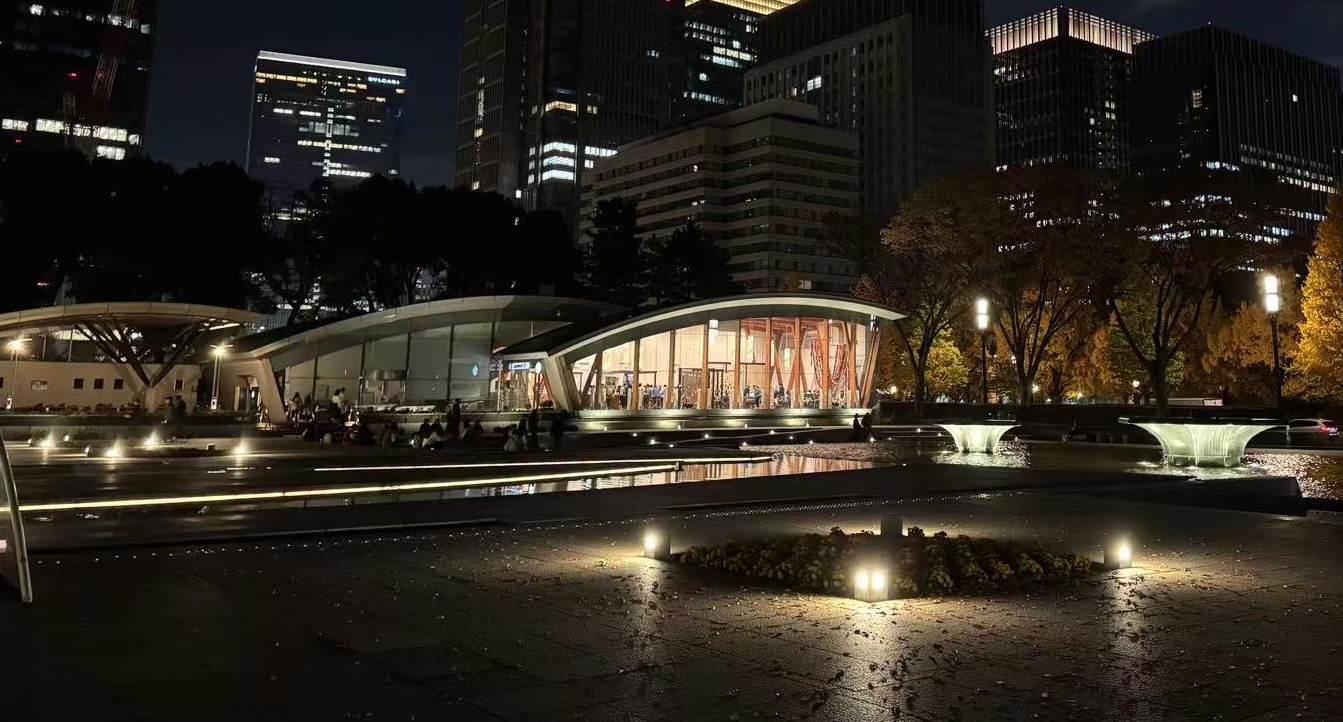
(A Starbucks near the Imperial Palace in Tokyo, photographed before Thanksgiving last year with a friend. It was packed inside and out. My friend and I talked about how it reminded us of the Starbucks that once existed inside Beijing's Forbidden City — except that one was short-lived, a microcosm of Starbucks' trajectory in China.)
China is not that market. At least not right now.
Earlier this year, Starbucks sold 60% of its China business to Boyu Capital. It retained 40% plus brand licensing fees.
Some call it value unlocking. I think a more accurate description is — monetizing before the brand premium disappears entirely.
Interestingly, Luckin has already opened ten stores in Manhattan, New York.
I walked past one and thought about it. If China's "low price plus app plus small store" model can work in New York, Starbucks' home-turf moat is not absolutely safe either.
Next, something far from daily life, but possibly the most unsettling part of the entire story.
Starbucks paid $2.77 billion in dividends last year. But its free cash flow was only $2.44 billion.
How does it cover the gap? Borrowing.
Over the past five years, dividends have grown 7-8% annually while free cash flow has been shrinking at 14% per year. Those two lines crossed in 2024 — from that moment on, Starbucks has been borrowing to pay dividends.
Even before that, the company had spent roughly $80-90 billion buying back its own stock. To what extent? Shareholder equity turned negative $8.1 billion.
Negative equity is not necessarily bad — McDonald's has it too. But 95% of McDonald's stores are franchised, margins are 46%, and return on capital is 35%. When McDonald's levers up, it is earning real money.
Starbucks operates 55% of its stores directly, margins are below 10%, and return on capital is 8.5%. Barely above the cost of capital.
Same negative equity, two very different stories. One is a deliberate choice. The other is a consequence.
It is like a person spending more than they earn every month, propping up a lifestyle with credit cards. No visible problem in the short term. Inevitable reckoning in the long term.
Finally, valuation.
82x P/E. The highest in the entire quick-service restaurant industry.
For that number to hold, three things must be true simultaneously.
First, last year's earnings were an abnormally low base. This part is reasonable — an unusually high tax rate plus upfront restructuring costs compressed profits. Normalize it, and the P/E is about 48x. Still expensive, but not insane.
Second, Niccol must recover margins at twice the speed he achieved at Chipotle. The market is implying 570 basis points of margin improvement within one year. We checked the entire industry's history and could not find a single company that achieved this without changing its business model. Niccol himself took six quarters to improve margins by 300 basis points at Chipotle — Starbucks needs him to go twice as fast.
Third, after recovery Starbucks must command the same valuation multiple as McDonald's. But Starbucks' franchise rate is 55%, versus McDonald's at 95%. These are not the same business.
All three beliefs must hold simultaneously. If any one fails, downside is 30% or more.
I am not saying Starbucks is a bad company.
When I am tired, I still push open that door and sit down. This brand is not going to disappear from my daily life.
But a place you enjoy visiting and a stock worth buying at 82 times earnings are two different things.
Every time I walk past one of those shuttered Starbucks, I think about what Schultz wrote in his books. The Starbucks he described — the aroma of coffee, the wooden tabletops, that feeling of the world going quiet when you step inside — it has not disappeared.
It is just waiting for the right price.