
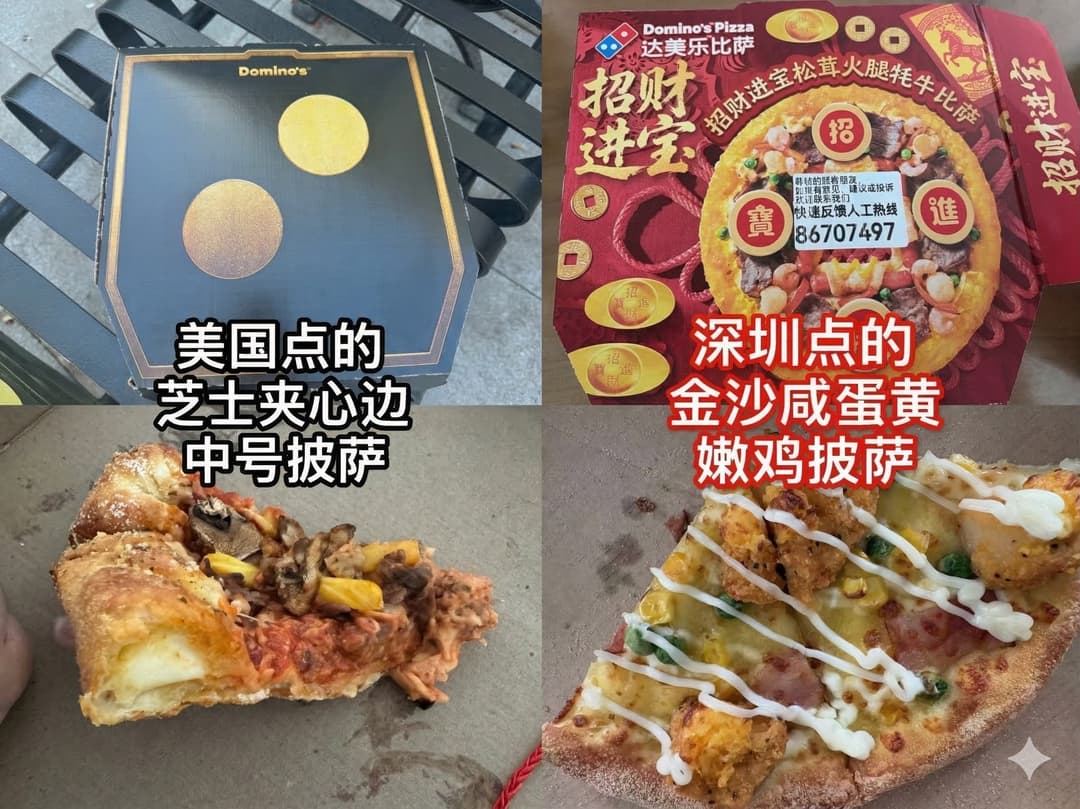
Pizza is such a basic part of American life that it almost disappears into the background. Back in school, one of the main incentives for going to seminars was the free pizza. Later, at work, whether it was an office event or a kid’s birthday party, pizza was always there. But to be honest, I never thought American pizza was all that good.
That changed when a friend in Shenzhen told me Domino’s in China was amazing, and sent me a photo: crispy chicken pizza with salted egg yolk sauce. I looked at it and thought — that is not the Domino’s I know. In China, the brand has already evolved into a completely different species.
Later, I ordered Domino’s in the U.S. for myself. It is the cheapest major pizza chain in America, yet somehow it tasted better than the local pizza places people usually order from for parties. I asked around, and quite a few friends felt the same way.
That was what made me curious about Domino’s. It is the number one pizza brand in the U.S. by market share, has more than 22,000 stores globally, and yet trades at a valuation about 17% below its peers. So my team and I started digging into the company seriously. 👉 Full DPZ Report
Let’s start with something counterintuitive.
When most restaurant chains expand, they open new stores in places where they do not already have one. Domino’s does the opposite — it keeps adding stores inside markets it already serves. In the same neighborhood, you can see multiple Domino’s locations only a few streets apart.
They call it fortressing — dense market reinforcement. On the surface, it sounds like self-cannibalization.
But the numbers tell a different story. Last year, Domino’s added 172 net new stores in the U.S. Over the same period, Pizza Hut closed 250. One is getting denser, the other is shrinking. Domino’s U.S. market share rose from 22.5% to 23.3%.
What is even more interesting is where the real value of this strategy comes from. Most people think denser store networks are about faster delivery. Not entirely. What they really shorten is the pickup trip.
The relationship between store distance and pickup behavior is not linear. Two miles is the cliff. If the distance drops from three miles to one and a half, a customer’s willingness to pick up almost multiplies by 2.5 times. By increasing store density, Domino’s is pushing more and more customers into the “it’s close enough to grab on the way” zone.
Why does that matter? Because while pickup tickets are about 18% smaller than delivery orders, they avoid delivery costs and platform commissions, which means they are actually more profitable. Last year, Domino’s pickup channel grew 5.8%, while delivery grew only 1.5%. The highest-margin channel is growing the fastest.
Here is another point that only makes sense when you see it in industry context.
Last year, the entire quick-service restaurant industry was raising prices. McDonald’s pushed too far, and its U.S. same-store sales turned negative — down 1.4%. Consumers voted with their feet.
Domino’s did the opposite. In the fourth quarter, same-store sales grew 3.7%, and management said something that stuck with me: pricing contributed zero. Every point of growth came from real people walking in and buying real pizza. Not a cent of it came from price increases.
They even launched a $6.99 carryout deal. In an environment where everyone else was raising prices, Domino’s chose to compete on value. Not because it had to, but because it understood the math. Lower prices bring customers in, carryout eliminates delivery costs and marketplace fees, and the profit per order can still hold up just fine.
At this point, there is one fact most people do not know.
About 60% of Domino’s revenue does not come from royalty fees on pizza sales. It comes from selling dough, cheese, meat, and ingredients to franchisees.
Domino’s operates 22 dough manufacturing and supply chain centers in the U.S. Franchisees are required to buy from them — not encouraged, required by contract. One hundred percent, no choice.
That means Domino’s is not just a pizza brand. It is also a food supplier with nearly 7,000 stores as a captive customer base. The annual food basket price rises about 3.5% a year. Royalty fees are 5.5%. Advertising fees are 6%. Supply chain profit adds another 3% to 4%. Technology fees take another cut. Add it all up, and Domino’s extracts about 15% to 16% from every dollar of store revenue.
What is interesting is that franchisees do not seem to resent it. Store churn is below 3%. More than 70% of new stores are opened by existing franchisees. It takes about $350,000 to $500,000 to open a store, and payback is around 2 to 3.5 years. Franchisees keep reinvesting their own money into the system. That is the clearest possible vote of confidence in the underlying economics.
At Shin Chan Theatre, we came up with a name for this structure: the benevolent dictator. Domino’s has near-total control over its franchisees, but it chooses to let them make money.
Next, let’s talk about a number that looks alarming at first glance.
Domino’s has negative shareholder equity of $3.9 billion.
Normally, when a company has negative equity, you think of financial distress. But Domino’s generated $670 million in free cash flow last year. Enough to cover interest, dividends, and buybacks, with room left over.
That negative equity comes from three things layered together. First, the company has bought back $5.5 billion of its own stock over the past decade-plus, effectively erasing book equity. Second, it carries $5.2 billion of securitized debt — fixed-rate financing backed by future royalty income. Third, the most valuable parts of the business — the brand, the 22,000-store franchise network, the 22 dough plants — are probably worth somewhere between $10 billion and $16 billion, but accounting rules do not allow those internally built assets to appear on the balance sheet.
Add those implied assets back in, and Domino’s adjusted equity is actually positive, somewhere around $6 billion to $12 billion. Negative $3.9 billion is an accounting appearance, not an economic reality.
Finally, valuation.
Domino’s trades at 23 times earnings. The average for quick-service peers is 28 times. That is about a 17% discount.
Is that discount justified? We ran a test. If you split Domino’s into two separate businesses — one a light-asset royalty platform, the other a dough-and-supply-chain company — value them separately, and then add them together, you get roughly $687 per share. The current stock price is $406. That is a 69% gap.
But if you use a traditional discounted cash flow model, you get about $414 per share — almost exactly where the stock trades now.
Same company. Two methods. Nearly a 2x difference.
That is not a modeling error. It is an identity problem. Do you think Domino’s is a royalty empire, or a pizza company carrying $5.2 billion of debt? Right now, the market is choosing the latter.
I am not saying Domino’s is definitely cheap.
But whenever I think about this company, my mind goes back to that photo my colleague in Shenzhen sent me. Crispy chicken with salted egg yolk. An American brand reinvented in China. A “pizza company” that gets 60% of its revenue from selling dough. A business with negative book equity that still throws off nearly $700 million in cash every year.
It is not the Domino’s most people think it is.
And whether you are looking at it as a consumer or as an investor, it may be worth taking a second look.