
Last time I wrote about Starbucks. Now I can't resist talking about Chipotle — because these two companies' fates were tied together by the same person.
The ancient Chinese poet Du Fu once wrote: "We only see the new bride smile; who hears the old one cry?" On Wall Street, that line has an exact price tag. In August 2024, Chipotle's CEO Brian Niccol announced he was leaving for Starbucks. The day the news broke, Starbucks surged 24.5% while Chipotle dropped 7.5%. The market moved roughly $26 billion in market cap from one company to another in a single day. One person left, and $26 billion followed.
Was Niccol worth that price? When he came over from Taco Bell in 2018, Chipotle was lying in the wreckage of its E. coli crisis — margins had fallen from 18% to 4%, and "would you dare eat at Chipotle?" was a social media meme. He did three things: launched a loyalty program that reached 28 million members in three years; rolled out Chipotlanes — dedicated digital order pickup lanes — in 85% of new stores; and pulled digital sales from near zero to over a third of revenue. Six years later when he left, margins were back to 17%, revenue had more than doubled, and total shareholder return exceeded 700%.
But what happened after he left was even more surprising. The P/E ratio compressed from 54x to 32x — a 40% drop. Meanwhile, earnings per share actually rose from $1.10 to $1.14. The company was making more money, yet the valuation shrank by 40%. Same-store sales went from positive 6% in his last quarter to negative 4% — the first full-year decline since the 2016 E. coli crisis. Traffic fell for four consecutive quarters, with 2.9% fewer visits over the past year. So my team and I started digging into this company seriously. 👉 Full CMG Report
Niccol's replacement, Scott Boatwright, is a completely different kind of leader. He started flipping burgers and washing dishes at McDonald's at age fifteen, worked his way up at Arby's from the ground floor to Senior VP of Operations overseeing 1,700+ stores, and delivered 26 consecutive quarters of positive same-store growth during his tenure. He doesn't tell stories to Wall Street, but he's doing something very specific — upgrading the equipment in every store.
Chipotle is rolling out a kitchen upgrade called HEEP. The centerpiece is a dual-sided plancha — it cuts chicken cooking time from twelve minutes to four. If you've been to Chipotle, you know the worst thing to hear in line is "the chicken isn't ready yet, please wait." Chicken accounts for 60% of protein selections, and the traditional grill takes twelve minutes per batch — running out during peak hours is routine. The dual-sided plancha turns that into four minutes. Capacity also triples. There's also an automated produce cutter — employees used to hand-chop hundreds of onions, tomatoes, and peppers every day. Now a machine does it, saving each store two to three hours of daily prep. So far only 350 stores have it — about 9%. The year-end target is 2,000 stores — 50%.
Management says HEEP can boost same-store growth by "several hundred basis points." But our team ran a bias analysis — the first 350 stores were likely cherry-picked, already high-traffic locations. Cut the number in half, and the real incremental lift is probably 150 to 200 basis points. Not nothing, but not enough to carry the entire valuation narrative either.
One CEO built the market cap to $78 billion. Another is trying to pull the P/E back up by shortening how long it takes to cook chicken. Which path leads further? Hard to say.
Speaking of Chipotle, here's a personal take. I think Mexican food and Mediterranean food are the two types of fast food closest to Chinese cuisine — rich seasoning, fresh ingredients, rice as the base. So Chipotle and CAVA are probably my two favorite American fast-food chains.
But I was shocked when I looked at the numbers recently. CAVA has only 439 stores. Chipotle has 4,056. Nearly a 10x gap in store count. Yet CAVA's market cap is $14 billion versus Chipotle's $49.5 billion — only a 3.5x gap. CAVA trades at 145 to 268 times earnings — four to eight times Chipotle's multiple.
What's even more interesting is the "fitness gap" between the two companies. CAVA's revenue growth is 21%, four times Chipotle's — but its profit margin is only 5-7%, less than half of Chipotle's 17%. One runs fast but barely makes money. The other makes money but can't run anymore. The market is pricing CAVA using Chipotle's growth trajectory from a decade ago. Chipotle took eight years to expand from 1,200 to 2,500 stores. CAVA's target is to grow from 439 to 1,000 in seven years. Whether it can replicate that path, nobody knows. But the market has already paid up front.
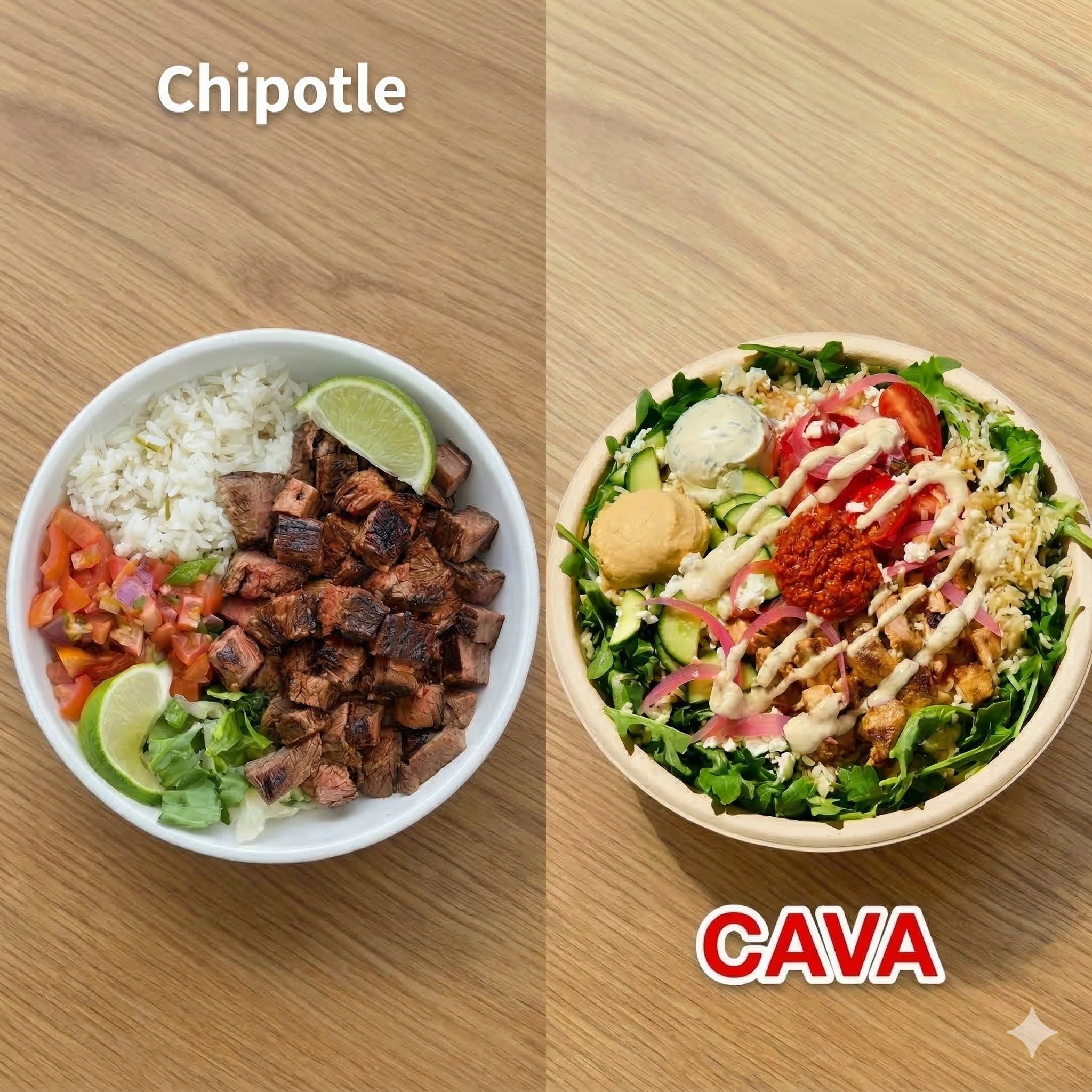
(Chipotle and CAVA bowls actually look quite similar, and I think they both taste pretty good. Of course, they can't compare to the incredible variety of food back in China — I'm always drooling over Xiaohongshu posts, even the delivery food looks amazing 😋)
Here's something counterintuitive.
Among nine major publicly traded fast-food and fast-casual companies — McDonald's, Starbucks, Yum Brands, Domino's — six have negative net worth. Chipotle is the only one with zero financial debt, plus $1.05 billion in cash on hand.
What does this mean? It means economic recession, credit tightening, interest rate spikes — all the things others fear most pose no threat to Chipotle. No debt to repay, no interest to pay. McDonald's pays nearly $1.4 billion in interest annually. Starbucks pays $2 billion. Those two numbers are equivalent to 97% and 138% of Chipotle's entire annual free cash flow, respectively. In other words, everything Chipotle earns in a full year of free cash flow wouldn't be enough to cover McDonald's interest payments.
But zero debt is actually a "disadvantage" in valuation models. Without low-cost debt to bring down the discount rate, Chipotle's discount rate is 9%. Debt-laden Starbucks has only 5.6%. The safer company, mathematically, looks more expensive.
But there's one number that makes me uneasy.
Last year Chipotle spent $2.43 billion buying back its own stock. Free cash flow was only $1.45 billion. Where did the extra nearly $1 billion come from? Eating into reserves — cash on hand dropped from $2 billion to $1.05 billion. If they keep this pace, cash hits near zero by year-end.
And last year's earnings per share growth — that 2.7% — was almost entirely driven by buybacks. Net income rose by only $2 million, from $1.534 billion to $1.536 billion. But because buybacks reduced share count, EPS "grew." The growth wasn't earned. It was purchased.
For a company whose identity is built on "zero debt," this year a choice must be made. Either slow down buybacks — which the market may read as "no growth opportunities." Or borrow for the first time — fundamentally changing this company's narrative. Neither path is easy.
There's something else you might not have noticed.
Of Chipotle's 4,000+ stores, only about 100 are outside the U.S. That's 2.5%. McDonald's gets over 60% of revenue from overseas. Starbucks, 40%. Yum Brands, over 50%. Chipotle is almost entirely an American company.
It insists on 100% company-owned operations — no franchising. This is Chipotle's proudest principle: every store is opened by the company, every employee is their own, and 85% of management is promoted from within. This system works brilliantly in the U.S. But international expansion requires franchise partnerships — Alshaya in the Middle East, Alsea in Latin America, SPC in Korea. This is effectively an admission that the company-owned model doesn't work outside America.
Management's long-term target is 7,000 stores in North America. Currently at 4,000, that's still 70% room to grow. But if that's the ceiling, the growth story will eventually hit a wall. And that ceiling is already coming into view.
Finally, valuation.
32x P/E. The lowest in five years. It was 54x in 2024. Looks much cheaper.
But this "cheapness" comes at a cost. A 25% tariff on avocados has pushed up food costs — half of avocados are imported from Mexico, and it's Chipotle's most iconic ingredient. Add in wage increases and new equipment depreciation, and this year's margins face nearly 200 basis points of pressure. Management says they'll "try not to raise prices" — meaning they're absorbing all these costs themselves.
More notable is the shift in consumer behavior. In 2022, Chipotle raised prices 10% and traffic actually increased 3% — consumers didn't care. But last year, with only a 2% price increase, traffic dropped 3%. The elasticity flipped. Same action — raising prices — but two years ago people were happy to come more often, and now they're starting to avoid it. Same-store growth guidance is "roughly flat." No growth, no decline.
At 32x, you're buying a company whose margins are being squeezed, growth has temporarily stalled, and consumers are starting to become price-sensitive.
I'll still go get a Burrito Bowl. Walking into a store and watching the kitchen crew slice meat, mix rice, and pile on toppings scoop by scoop — that feeling of "this is made fresh right here" is rare in American fast food.
But Du Fu's couplet works in two halves here. In the last article, Starbucks poached a CEO and surged $21 billion in a day — the new bride smiles. In this article, CAVA commands a third of the market cap with a tenth of the stores — another new bride smiling. Chipotle lost both its storyteller and its premium valuation — the old bride on both counts.
Is the old bride undervalued, or are both new brides overpriced? I don't know. But I do know that Wall Street moving $26 billion didn't make a single piece of chicken cook any faster. The person trying to do that is someone who started flipping burgers at McDonald's at fifteen, armed with a plancha that cuts twelve minutes down to four.
How the story unfolds from here could go many ways. Let's wait and see.