
📚 My Bookmarks
No bookmarks yet
Use the chapter navigation to jump around this report.
ServiceNow (NOW): Enterprise Execution Rights in the AI Agent Era, From Customer Adoption to Per-Share Cash
ServiceNow (NYSE: NOW) In-depth Equity Research Report
Update: In the March version, we framed our view of NOW in two layers: the company was of very high quality, but the price at the time had already reflected considerable optimism, leaving an adequate margin of safety only at a lower valuation. Over the past several quarters, ServiceNow has demonstrated through subscription revenue, cRPO, AI ACV, and large-customer expansion that AI is not merely a demo-layer concept; customers are genuinely willing to allocate budgets to Now Assist, AI Control Tower, and related workflows. The question has therefore shifted from “Will AI fundamentally weaken ServiceNow?” to “Can incremental AI revenue, acquisition integration, and margins ultimately translate into per-share cash?” At approximately $125 on August 12, the stock is no longer inexpensive, and the margin of safety is limited; below $110, the risk-reward profile would look materially more attractive and would be better suited for gradually establishing a starter position. This report does not treat any specific price as a mechanical buy point. The core remains continued validation through contracts, gross margin, cross-selling from acquisitions, and free cash flow per share.
ServiceNow has long served as the accountability and execution layer for large enterprises. AI will determine whether this layer of accountability can expand into a production control point spanning multiple agents—and ultimately translate into per-share cash.
Chapter 1: Investment Conclusion: The Core Asset Predates AI, While the Valuation Ceiling Depends on Whether Agents Still Pass Through It
Before generative AI emerged, ServiceNow had already become a layer of “accountability and execution control” within large enterprises. It does not own every authoritative record for employees, customers, orders, and the general ledger, nor does it need to be the first interface employees open each day. Its value lies in connecting actions scattered across Workday, Salesforce, SAP, Microsoft, and internal systems into a traceable chain of work: who initiated a request, who approved it, which systems were invoked, where failures occurred, how they were remediated, and who ultimately closed the case. The ticketing interface is only one entry point; the hardest elements to migrate are process states, permission boundaries, exception rules, and audit evidence.
AI Agents did not create this position, but they have changed four variables: the initiator of work has expanded from humans to machines; entry points have spread from the ServiceNow portal to Copilot, Claude, and internally developed assistants; action volumes could multiply; and both the speed of erroneous write-backs and their accountability consequences are increasing in parallel. The winner in the AI era will be determined by whether third-party Agents executing high-risk actions in production environments must still pass through ServiceNow’s authorization, workflows, exception recovery, and auditing. If they continue to pass through the platform, fragmented entry points will increase governed actions; only if they bypass the platform will ServiceNow deteriorate into a back-end system of record or an ordinary connector.
Microsoft is the company best positioned to challenge this role. It simultaneously owns default entry points such as Teams, Outlook, and Windows; Entra identity; Defender/Purview security and compliance; and Copilot Studio, Foundry, and Agent 365. ServiceNow’s advantage, meanwhile, lies in long-running work states across heterogeneous systems, complex approvals, service levels, exceptions, and recovery. The base-case structure is more likely to be layered coexistence: Microsoft manages entry points, identity, and the Agent workforce; ServiceNow manages cross-system business actions and chains of accountability; and systems such as Workday, Salesforce, and SAP preserve authoritative facts and complete final write-backs. The two companies will cooperate while also competing for governance budgets and control-plane boundaries.
Moveworks, Armis, and Veza fill three gaps in this competitive picture. Moveworks adds an employee-facing interface and enterprise search; Armis adds asset and exposure coverage across IT, OT, IoT, and medical devices; and Veza adds identity and permission relationships. Combined with ServiceNow’s existing CMDB, Context Engine, Action Fabric, and AI Control Tower, they could theoretically answer: “Who, under what permissions, can perform what action on which asset, and with what result?” The opportunity is real, but so is the cost: the three transactions created more than $9 billion in goodwill and identifiable intangible assets; Armis required debt financing and dilutes near-term margins; and Moveworks involved substantial stock consideration. The product portfolio will generate shareholder returns only if it translates into cross-selling, retention, gross margin, and free cash flow per diluted share.
Operating evidence remains broadly positive, but its quality requires closer examination. In the second quarter of 2026, subscription revenue reached $3.877 billion, up 24.5% year over year and 23% in constant currency; cRPO was $13.2 billion, up 21.5% in constant currency; broad AI annual contract value exceeded $1 billion; and the number of customers with ACV above $5 million reached 658. At the same time, the consolidation of Armis, accelerated recognition of on-premises revenue from U.S. federal customers, and early renewals all boosted second-quarter performance. The company has not yet fully disclosed a comparable organic growth bridge, standalone AI renewals, net realized pricing, or product-level gross margin.
Based on the August 12, 2026 share price of $124.94, market capitalization is approximately $129.2 billion. Using this report’s estimate of $5.2 billion to $5.4 billion in normalized 2026 free cash flow, enterprise value is approximately 24 to 25 times normalized FCF. The current price is suitable for initiating research and small-scale validation, but the base-case return still requires organic contract growth to remain in the high teens, subscription gross margin to stabilize, acquisition cross-selling to emerge, and cash flow per share to continue increasing. The risk-reward becomes more attractive below $111, while only below $100 does the stock approach a range offering substantial protection even under the downside scenario; every price range assumes that the underlying operating fundamentals have not deteriorated concurrently.
Core judgment: ServiceNow already owns the accountability layer; AI will determine whether that accountability layer expands into a production control point across Agents. Downside protection comes from embedded process states and recovery accountability; upside comes from the volume of governed actions generated by external Agents; and the greatest valuation risks are Microsoft’s expansion into the business execution layer and high-priced acquisitions failing to translate into per-share cash flow.
Investment Conclusion Card
| Dimension | Current Assessment | Evidence Determining the Conclusion |
|---|---|---|
| Company quality | High | Years of subscription revenue, cash flow, and large-customer expansion have demonstrated platform stickiness |
| Moat | Established before AI; depth depends on implementation quality | The more complete the approvals, permissions, write-backs, exceptions, recovery, and auditing, the harder the migration |
| Position in the AI control layer | The accountability layer for cross-Agent business actions, but not yet the sole control plane | If governed production actions continue to pass through the platform, fragmented entry points will instead expand workloads |
| Primary threats | Microsoft determines the ceiling, while domain-specific and security platforms siphon off adjacent actions | ServiceNow does not exclusively control entry points, master data, identity, or real-time blocking |
| Capital allocation | Strategic portfolio is coherent; shareholder returns remain unproven | Moveworks, Armis, and Veza add entry points, assets, and permissions, but also bring goodwill, debt, and share issuance |
| Conclusion at the current price | Underwritable, but not cheap | EV/normalized FCF is approximately 24 to 25 times; the base-case path requires continued execution |
| Most important validation period | The next two to four quarters | Organic cRPO, AI renewals, subscription gross margin, acquisition cross-selling, and cash flow per diluted share |
Key Data at a Glance
| Metric | Latest Data | Investment Implication |
|---|---|---|
| Share price and market capitalization | $124.94; approximately $129.2 billion | Pricing date is 2026-08-12; the stock has already captured most of the post-earnings valuation recovery |
| Q2 subscription revenue | $3.877 billion; +24.5% | Up 23% in constant currency; includes impacts from Armis and revenue-recognition timing |
| cRPO | $13.2 billion; +21.5% in constant currency | A solid contracted base for the next year, but not equivalent to 21.5% purely organic growth |
| AI annual contract value | More than $1 billion | Customers are already paying, but standalone renewals and product-level profitability remain unproven |
| Large customers | 658 customers with ACV above $5 million | Approximately +23% year over year; multi-product cross-selling continues to deepen |
| 2026 normalized free cash flow | Approximately $5.2 billion to $5.4 billion | Analytical estimate after retaining necessary investment and acquisition-transition impacts |
| Valuation at the current price | EV/normalized FCF of approximately 24 to 25 times | Underwritable, but returns depend on continued delivery of growth and gross margin |
Sources: ServiceNow second-quarter 2026 earnings release and second-quarter 2026 Form 10-Q; share price and market capitalization as of 2026-08-12. Normalized free cash flow and valuation are estimates calculated in this report.
Four Questions That Determine the Ultimate Source of Returns from This Investment
First, whether third-party Agents must still pass through ServiceNow. Who owns the entry point is not the ultimate issue. Durable monetization power depends on whether an action can bypass the platform’s states, authorization, write-backs, and auditing. If external Agents merely initiate requests, ServiceNow may still expand its workload; if they also take over the accountability layer, the platform’s value will decline.
Second, whether AI contracts can translate into renewals, gross margin, and cash flow per share. More than $1 billion in AI ACV rules out the bearish view that there are “only demonstrations and no customers,” but it does not answer questions about bundle discounts, unused capacity, inference costs, and renewal quality. Production usage and cash flow per share matter more than the number of product launches.
Third, whether the three acquisitions can increase per-share value. Moveworks, Armis, and Veza respectively add an employee-facing entry point, asset risk, and identity permissions, but the three transactions created more than $9 billion in goodwill and intangible assets and shifted the company from a net cash position to modest net debt. Synergies accrue to common shareholders only if cross-selling growth covers integration, interest, share issuance, and share-repurchase costs.
Fourth, whether implementation quality creates a data asset or technical debt. Standardized processes, an accurate CMDB, clear permissions, and stable interfaces raise expansion and migration costs; legacy scripts, duplicate fields, and excessive customization slow upgrades, increase total cost, and allow Agents to amplify errors more rapidly. Only sustainable business outcomes can convert software stickiness into a moat.
Reading Order
The report first explains the respective roles of ServiceNow, systems of record, and implementation partners, then examines control-layer competition in the age of AI Agents. It subsequently evaluates AI contracts, the three acquisitions, gross margin, and cash flow per share, before using scenario-based valuation and a falsification checklist to constrain the investment judgment. The appendix retains product explanations, financial concepts, and sources for reference by non-specialist readers.
Chapter 2: Customers Pay for a Chain of Accountability That Gets Work Done
An Employee Offboarding Process Explains the Entire Company
Suppose an employee leaves the company. Workday first confirms the employee’s status; ServiceNow initiates approvals based on the role and region, assigning tasks to IT, security, facilities, and finance; Microsoft Entra revokes account access; the asset system arranges for the return of the employee’s computer; and the finance system terminates expense reimbursement privileges. Finally, the enterprise must know who approved each step, who executed it, when it was completed, which steps were missed, and how to recover when something goes wrong.
The employee may see only a single request, but the enterprise is purchasing a coordination mechanism. It reduces three types of costs: time lost while departments wait on one another, operating losses caused by incorrect permissions or erroneous changes, and accountability costs arising from regulatory audits and incident investigations. The larger the enterprise, the more systems it operates, and the stricter its regulatory environment, the higher the cost of a failed process—and the more willing customers are to pay continuously for reliable status, permissions, and audit records.
This also explains ServiceNow’s expansion path. The company initially moved incidents and requests out of phone calls, emails, and spreadsheets and into the cloud. It then added a configuration management database (CMDB), IT operations, and asset and change management, linking tickets to servers, applications, and business services. As the platform matured, it expanded into human resources, customer service, security, risk, and low-code development. The number of product names has continued to grow, but the underlying job has not changed: enabling multiple departments and systems to act around the same work status while maintaining an accountable record of the outcome.
ServiceNow was founded by Fred Luddy around 2004 and listed on the New York Stock Exchange in June 2012. After Bill McDermott became CEO in 2019, the company accelerated its push toward becoming a platform for large enterprises and expanded cross-departmental sales. In 2019, the company generated approximately $3 billion in annual revenue, with only one business exceeding $1 billion in annual contract value; by 2025, subscription revenue had reached $12.883 billion, and the company expects five businesses to exceed $1 billion in annual contract value in 2026. More than 90% of customers now use multiple workflows.
Figure 1 ServiceNow’s product expansion has consistently deepened along enterprise actions
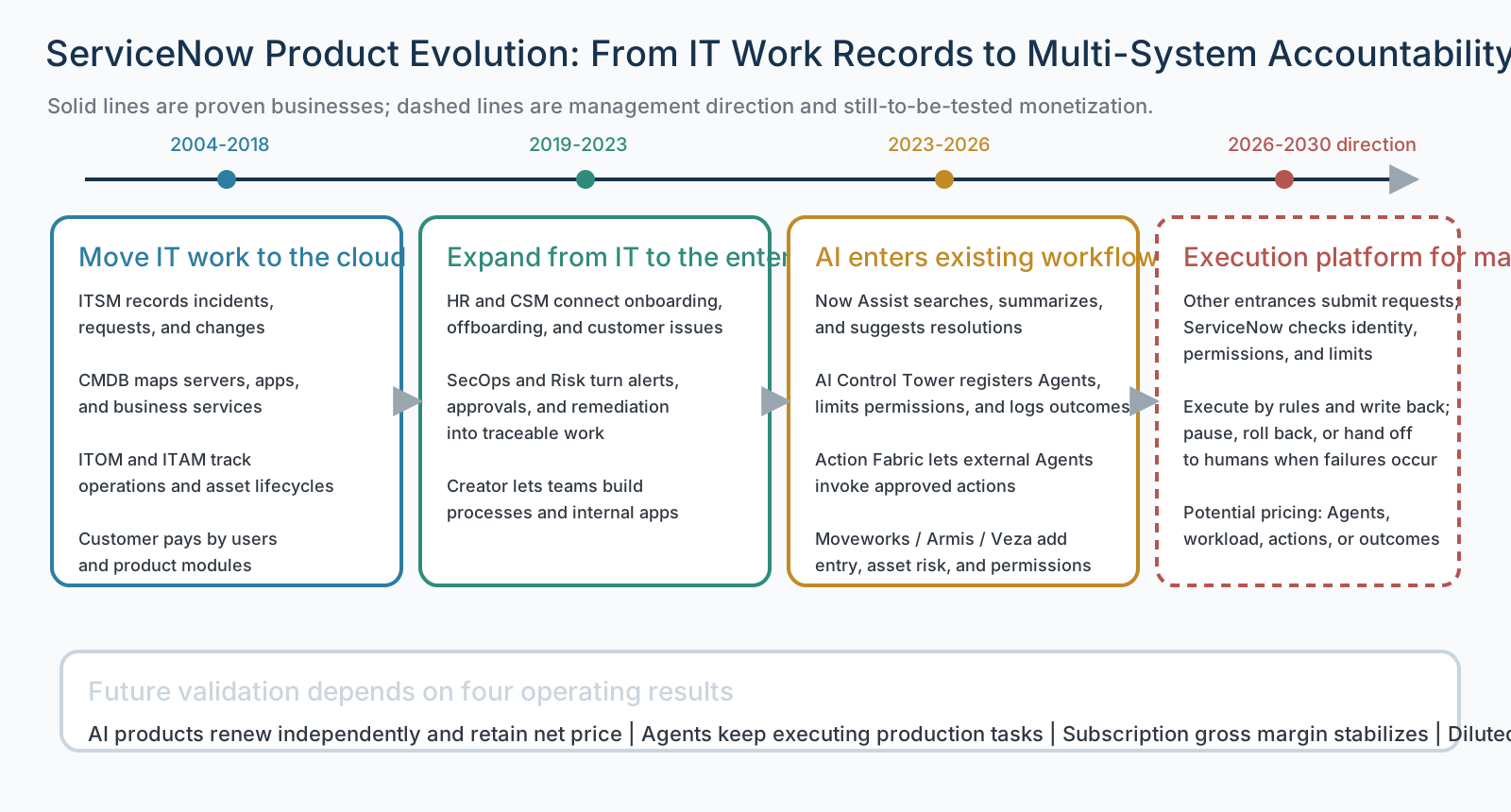
Source: ServiceNow company disclosures and product materials; compiled by the author. The first three stages are supported by product and contract evidence; 2026–2030 represents a directional assessment.
Five Product Groups Serving the Same Chain of Work
| Product group | Work the customer needs to complete | Primary buyer | Areas controlled by ServiceNow |
|---|---|---|---|
| Technology workflows | Incidents, requests, assets, operations, changes, and projects | CIO, IT operations, and development teams | Tickets, configuration relationships, approvals, service status, and historical records |
| Employee and customer workflows | Onboarding, employee services, customer cases, and field service | HR, customer service, operations, and shared-services leaders | Cross-departmental tasks, case status, and service deadlines |
| Creator and data | Build internal applications, connect external systems, and unify context | Platform teams, enterprise developers, and digital transformation teams | Custom data, interfaces, workflows, and application governance |
| AI and agents | Understand requests, execute automatically, and manage different agents | CIO, AI platform leaders, and business leaders | Context, tool calls, governed actions, and audits |
| Security, assets, and identity | Discover assets, vulnerabilities, risks, and anomalous permissions and drive remediation | CISO, risk, and identity teams | Risk status, accountability assignment, remediation workflows, and evidence |
Sources: ServiceNow product materials, 2025 Form 10-K, and Q2 2026 Form 10-Q; reclassified by the author based on customer workflows.
Technology workflows remain the foundation of the platform. IT service management handles incidents, requests, and changes; IT operations management identifies relationships among servers, networks, cloud resources, and applications; and asset management records the lifecycles of hardware, software, and contracts. The CMDB is particularly critical: when relationship records are accurate, incident diagnosis, change assessment, and agent execution are more reliable; when records are disorganized, automation merely amplifies errors more quickly.
Employee and customer workflows bring the platform into new budgets. Onboarding simultaneously involves HR, IT, finance, and facilities; a customer complaint may involve customer service, warehousing, field personnel, and finance. Moveworks improves enterprise search and the natural-language interface, while ServiceNow routes requests into back-end workflows. The company has disclosed that its CRM business has approximately $2 billion in annual contract value, indicating meaningful scale, although revenue and profit have not yet been disclosed separately.
Low-code tools, IntegrationHub, Workflow Data Fabric, and Context Engine enable customers to connect SAP, Workday, Salesforce, Microsoft, and internal systems. If customers can continuously add workflows on top of existing data, permissions, and audits, ServiceNow becomes an extensible platform; the various modules are simply delivery mechanisms.
ServiceNow, Systems of Record, and Implementation Partners Each Solve Different Problems
Enterprise software vendors play different roles. Workday, Salesforce, and SAP are closer to domain-specific systems of record: they maintain authoritative facts about employees, customers, orders, and finances and execute transactions within their respective domains. Microsoft simultaneously owns the productivity interface, identity, security, cloud, and development platforms. ServiceNow orchestrates work across these systems and maintains shared progress. Accenture, Deloitte, Capgemini, and others are implementation and transformation service providers that help customers turn software into an operational organizational mechanism; they generally do not own the authoritative records or workflow platforms that customers use over the long term.
| Participant | What it is best at storing or controlling | Typical service scenarios | Relationship with ServiceNow |
|---|---|---|---|
| ServiceNow | Cross-departmental task status, approvals, service levels, exceptions, and audits | IT services, employee services, customer service, security response, risk, and custom workflows | Horizontal accountability and execution layer that invokes other systems to complete actions |
| Workday | Authoritative records for employees, positions, compensation, and finance | Recruiting, onboarding, transfers, departures, payroll, talent, and financial processes | Provides workforce and financial facts and may also assume control of agent management within its domain |
| Salesforce | Customer, lead, opportunity, contract, and service records | Sales, marketing, customer service, and revenue processes | Provides customer facts and competes with ServiceNow in front-office workflows |
| Microsoft | Employee interfaces, identity, endpoints, collaboration, security, and cloud operating environments | Teams/Copilot, Entra, Defender, Azure, and Power Platform | A critical upstream provider and partner, as well as the competitor with the broadest control plane |
| Implementation partners such as Accenture | Project methodologies, industry processes, integration, and organizational transformation capabilities | Process redesign, data migration, system integration, rollout training, and operational transformation | Help deploy the platform; earn project service fees but are not primary systems of record |
These five categories of capabilities can coexist. In an employee offboarding scenario, Workday confirms the departure, Microsoft Entra executes access revocation, ServiceNow records approvals and each department’s completion status, Salesforce or SAP handles outstanding customer-, expense-, or order-related matters, and the implementation partner designs interfaces, roles, testing, and exception handling during the project phase. Competition arises when an upstream or domain-specific system fully takes back control of a particular category of actions.
The Meaning of “Professional Services”: Turning SaaS into an Operational Business Mechanism
ServiceNow’s professional services encompass implementation, integration, and transformation work. Large projects typically include four categories of tasks: configuring fields, roles, approval paths, service levels, routing, and forms; handling data and integration by cleansing asset and organizational data, establishing the CMDB, migrating historical records, and connecting Workday, Salesforce, SAP, Microsoft, and legacy systems; developing scripts, applications, or interfaces for extensions and customizations only when standard configurations cannot meet critical requirements; and covering access testing, disaster recovery, training, process ownership frameworks, and ongoing post-launch governance through testing and organizational transformation.
Large projects are jointly undertaken by three parties. Customers must determine business processes, data ownership, risk tolerance, and ultimate accountability; ServiceNow provides the product, reference architecture, technical support, and selective consulting or acceleration services; systems integrators are responsible for process redesign, migration, integration, extensions, global deployment, and change management. When requirements are unclear, foundational data is poor, or customers insist on replicating legacy processes, even the strongest implementation partner cannot turn the project into a high-quality asset.
In 2025, professional services and other revenue accounted for approximately 3% of ServiceNow’s total revenue and generated a negative gross margin. The company relies on partners to perform most implementation work, while its core profit continues to come from software subscriptions; this model also expands delivery coverage. Investors cannot focus only on license fees: the total cost of ownership for large customers also includes consultants, internal project teams, data cleansing, integration, upgrades, and long-term administration.
Implementation quality directly changes the nature of the moat. Standardized processes, an accurate CMDB, clear permissions, stable interfaces, and testable exception paths make customers more willing to add modules and enable agents to execute safely; duplicated fields, legacy scripts, and excessive customization slow upgrades, increase maintenance costs, and amplify errors. The former creates high switching costs rooted in business operations; the latter is merely technical debt. Whether future AI revenue materializes depends partly on whether these large implementations have already established a robust chain of accountability.