
Opening: The Night No One Would Sign
On the night of March 3, 1933, there was a brightly lit room in the White House in Washington, where a group of people gathered around a piece of paper, waiting for a signature. That piece of paper was an order to close all banks across the United States for a holiday.
There was no other way left. The central bank of the United States is the Federal Reserve System, commonly called the Federal Reserve or the Fed. Its most important regional bank is the Federal Reserve Bank of New York. The previous afternoon, the New York Fed had informed Washington that its gold holdings had fallen below the legal limit. On March 3, another $350 million flowed out: $200 million was wired abroad, while depositors waiting in line withdrew $150 million in cash. New York asked the Chicago Fed for a loan and was turned down. At that rate, it would have no money left to meet withdrawals when the banks reopened on Monday.
No one in the room was arguing about whether the order should be signed. They were arguing about who should sign it. Republican president Herbert Hoover had lost the November 1932 election to Democrat Franklin D. Roosevelt, but under the rules then in force, the new president would not take office until March 4. For four months, the outgoing president had lost his authority while the president-elect still had no power. This was the final night of that interregnum: by noon the next day, Hoover would no longer be president.
There was a courtesy tea party that afternoon. After the tea party, Hoover asked Roosevelt to sign a proclamation with him to close all banks. Roosevelt was unwilling to take responsibility for other people's messes before taking office. His wife heard her husband reply through the door: Go to hell, you don’t have the guts to do it yourself, I will wait until I become president. The two of them talked on the phone three more times that night, once at 8:30, once at 11:30, and once at 1:00 in the morning. No one would give in. The governors of the Federal Reserve drafted a letter overnight, imploring the president to order it, and sent it to the White House at 2 a.m. The president had fallen asleep, and no one dared to wake him up, so the letter had to be stuffed through the crack in the door.
In the end, state governors acted. At 2:30 a.m., New York declared a three-day bank holiday. Illinois followed an hour later; Massachusetts and New Jersey did the same early that morning. By the time Roosevelt was sworn in on March 4, banks were closed in twenty-eight states and operating under restrictions in the other twenty. Army machine guns had been positioned beneath the steps of the Capitol.
This was the country that held more gold than any other in the world.
When people think of the Great Depression, the first thing that often comes to mind is the Wall Street crash of October 1929, as if it all started there. But if we only start from Wall Street, there are four things that make no sense.
Why is the recession still deepening year after year after the stock market crash has passed?
The United States has the most gold in the world, so why are banks closing in droves?
Britain gave up the gold standard and later slowly recovered; France maintained its huge gold reserves, but why was it trapped for longer?
There was no shortage of people who saw it right at that time, so why didn’t it work?
From 1929 to 1933, world industrial output fell by about a third, and in some countries one in four workers lost his job. To answer the above four questions, we have to go back fifteen years and start with World War I.
I. Three Traps, Set and Ready (1914–1928)
Let’s start with what the world was like before the war. At that time, the monetary system implemented by major countries was called the gold standard. It sounds simple: the government promises that its banknotes can be exchanged for gold at a fixed price at any time. One pound can always be exchanged for so much gold, and one dollar can always be exchanged for so much gold. So the price ratio between pounds and dollars is fixed, and business people don't have to worry about the exchange rate. This promise is reassuring, but the price is that the central bank's hands are tied: how much gold it has in its hands roughly determines how much money there is in the country. When gold flows out, it has to raise interest rates and tighten monetary policy to keep the gold, regardless of whether domestic factories and workers can bear it at the moment. Please keep this in mind, as the rest of the story revolves around it.
The center of this system is London. Before World War I, about 60% of the world's trade was settled with bills drawn in London. When a Brazilian coffee merchant sells goods to an importer in Hamburg, Germany, the payment often goes through a note in London. Interestingly, there is not much gold supporting this large network. The Bank of England, the central bank of the United Kingdom, has only about US$200 million in reserves. It does not need to hold gold for every transaction because most bills are not called for cash on the same day. Ultimately, the entire system relies on people believing that tomorrow will be similar to today.
At the end of July 1914, war came, and this belief was suddenly gone. In just five trading days, exchanges in Vienna, Berlin, Paris and London closed their doors, and the New York Stock Exchange closed on July 31, remaining closed for four months. Just a few weeks before the war began, nothing unusual could be seen in London's interest rates. The market did not see the disaster in advance. It just continued to live according to the day in front of it until the day when it could no longer survive.
The war lasted four years, and the center of world finance also crossed the Atlantic during these four years. Britain and France wanted to buy arms and food. If they didn't have enough money, they borrowed money from the United States. During the fiercest months of the Battle of the Somme in 1916, Morgan & Co., the most powerful bank on Wall Street, spent more than one billion U.S. dollars on purchases in the United States on behalf of the British government, accounting for approximately 45% of all British war expenditures during the same period. By the end of the war, the United States had gone from being a debtor to being the largest creditor of all the warring nations.
After the war, various countries gradually reinstalled the gold standard. Central bank governors are particularly insistent on this matter, and there is a reason why they do not say it out loud. During a war, the owner of the currency is the government, and the central bank has to print as much money as the government wants. Norman, the later governor of the Bank of England, who had been in charge of the bank since 1920, always remembered the scene in 1917: the then governor was called to reprimand by the Prime Minister for contradicting the Treasury and was forced to apologize. For people like him, returning to the gold standard is not just about restoring a set of exchange rates, but also about taking the keys to money printing back from politicians and locking them again.
But when the system was put back together, three things were different from before the war. They were like three traps that had been set and wound tight, each waiting for the day it would be triggered.
The First Trap: A Circle of Debt
Fighting wars costs astronomical amounts of money, and only a small part of that money comes from taxes. Britain paid about 20% of its war expenses with taxes, Germany about 10%, and France not even 5%. The rest relies on borrowing money and printing money. To put it bluntly, this means deferring the debt to the future. What's even more troublesome is that all three countries are counting on others to pay the bill: Britain is waiting for its allies to return the loans, France is waiting for Germany to pay reparations, and Germany originally planned to ask the enemy to compensate after winning the war. These three hopes cannot be realized simultaneously.
After the war, the victorious countries met in Paris and signed the Treaty of Versailles, requiring Germany to compensate for the losses caused by the war. However, it has not yet been determined how much compensation should be paid. The numbers are not difficult to calculate, but the difficulty is that no one dares to tell the real numbers to voters. Politicians from various countries have promised that Germany will pay the full price. If they set the figure too high, Germany cannot afford it, and if they set the figure too low, their own people will not agree.
So from 1919 onwards, the deferred accounts were connected in a circle. Germany paid reparations to France and Britain; France and Britain used the money to repay war loans they owed the United States; American banks and investors lent money to Germany so that Germany could pay the next installment of reparations.
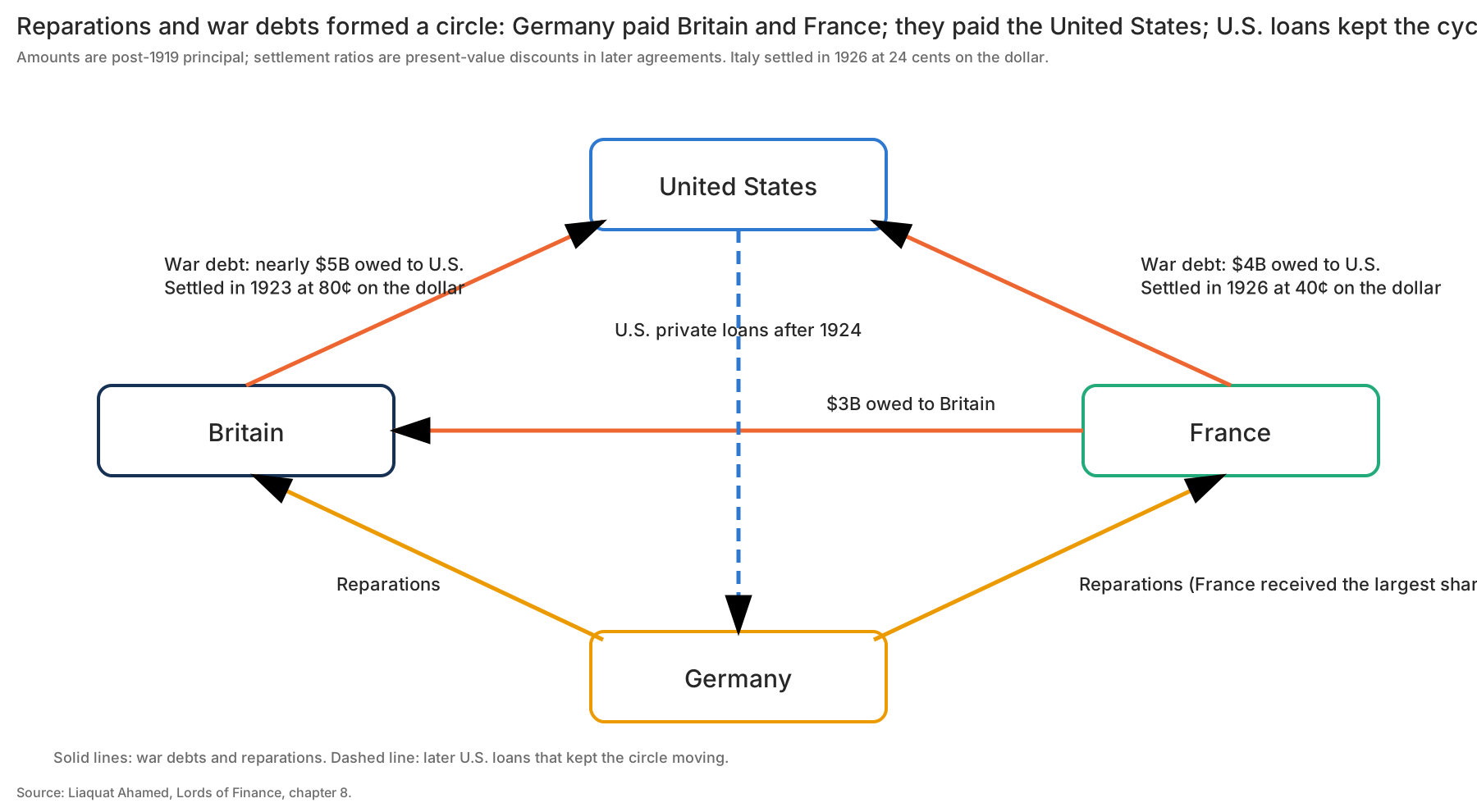
It is not difficult to see that there is only one driving force in this circle, which is the new loans that the United States lends abroad every year. One person saw the danger right then. His name is Keynes, a young British economist who participated in the Paris Peace Conference as a representative of the British Treasury and later became the most influential economist in the twentieth century. In 1919, he suggested that war debts and reparations be written off in one go, but the United States did not agree. The American principle also makes sense: money is lent out in real money, and it is natural to pay back debts. As long as American money continues to flow out, the circle can keep spinning. It has been spinning for many years, and few people have seriously thought about what would happen if it stopped.
The German link is particularly vulnerable. In 1923, the German government relied on printing money to meet expenses, leading to hyperinflation, and the mark was almost turned into useless paper. This inflation swallowed up three-quarters of the capital of German banks and wiped out people's deposits. If banks want to grow bigger again, they can only rely on short-term funds deposited by foreign banks. After 1924, American money poured into Germany, amounting to about 1.5 billion US dollars in two years, three times the amount of reparations in the same period. Germany's prosperity is back, but this prosperity is borrowed, borrowed from other people's currency, and may be taken back at any time.
The Second Trap: Two Mispriced Exchange Rates and a Line Written into a Treaty
To return to the gold standard, one thing must be decided first: at what price the national currency will be exchanged for gold. Britain and France each made mistakes in opposite directions.
On April 28, 1925, British Chancellor of the Exchequer Churchill (later the Prime Minister during World War II) announced that Britain would return to the gold standard at the old pre-war price, with one pound still worth $4.86. The problem is that after four years of war, British prices have risen. At that time, all parties generally acknowledged that based on this exchange rate, British goods were about 10% more expensive than American goods. This meant that British coal, cotton, steel and ships became 10% more expensive on the world market overnight and could no longer be sold. Keynes wrote three articles in a row to oppose it. His algorithm was very straightforward: the 10% increase in the exchange rate could only be made up by a 10% reduction in domestic wages and prices. The only way to make workers accept the wage reduction was to make enough people unemployed.
In fact, the Bank of England had never calculated the adjustment with much rigor. Six or seven estimates circulated internally, all producing different answers. Montagu Norman, the Bank's governor, added them together and took the average. In the years that followed, unemployment in British industry remained around 10%. In 1926, mine owners demanded wage cuts; the miners struck, and the dispute grew into a nationwide general strike that lasted ten days. Two years later, Churchill acknowledged that the return to gold had been a miscalculation.
France went in the opposite direction. The franc fell badly after the war, eventually settling at about twenty-five francs to the dollar, only one-fifth of its pre-war value. The price was on the low side, and French goods appeared cheap abroad, but the French themselves did not see it that way. The domestic debate at that time was whether the franc would be set too high. Some cotton mill owners complained that as soon as the franc appreciated, customers began to reject goods, as if everyone suddenly ran out of cash.
One is set high and the other is set low, and the consequences can be imagined: money and gold flow from London to Paris. Britain is increasingly struggling, and France's coffers are getting fuller.
The German side installed something else. Its laws stipulate that for every one hundred mark banknote issued by the central bank, it must have at least forty marks of gold and foreign exchange as guarantee. This is called a 40% reserve ratio. Looking at it from another perspective, one hundred units of gold can support up to 250 units of banknotes. For every unit of gold lost, domestic money will shrink by 2.5 units. This line is not something that Germany can change if it wants to. It is part of the reparations agreement. Changing it is tantamount to unilaterally tearing up an international contract.
In July 1927, the heads of the four central banks of Britain, Germany, France and the United States gathered for five days on Long Island, New York. The reason for this meeting was that the pound was struggling to hold up. On the American side, Strong, the president of the Federal Reserve Bank of New York, was present. He was the most knowledgeable person in international finance in the United States at the time and had a close personal relationship with Norman. Strong decided to lower interest rates in the United States so that money would not rush from London to New York, which would reduce the pressure on the pound. He was reminded that low interest rates would fuel an already hot stock market. He said with a wry smile that it was a "little sip of whiskey" for the stock market. At that time, the Dow Jones Industrial Average (hereinafter referred to as the Dow), the most commonly used index for the U.S. stock market, was around 170 points.
In those five days, some people actually saw further dangers. Leffingwell, a partner at Morgan, reminded the French: If all European countries replenish their gold reserves to pre-war levels and everyone grabs gold together, world prices will be suppressed, and the industrial sector will usher in a particularly dangerous depression. The other party answered him that prices in the United States have also been falling in the past two years, and aren't they still experiencing unprecedented prosperity?
The Third Trap: The Wrong Lesson from an Earlier Crisis
The third trap lay in the lessons people carried in their heads.
In 1920, the Federal Reserve raised the rate at which it lent to banks to 7% in an effort to curb postwar inflation. The medicine was administered so aggressively that wholesale prices in the United States fell 45% between May 1920 and January 1922, while more than 2.5 million people lost their jobs. The government stood aside. The economy bottomed on its own in July 1921, and by May 1923 industrial production had rebounded 63%, ushering in the boom of the 1920s.
The reason why this rebound came so quickly was because of two conditions that few people paid attention to at the time. First, at that time, most countries in the world had not yet returned to the gold standard. Other countries did not follow the United States in tightening the standard. Instead, gold flowed to the United States, and the constraints were soon loosened. Second, there was no nationwide series of bank failures in the United States, and companies were still able to borrow money. But what people remember from this incident is another one, which is much simpler: No matter how deep the recession is, as long as you bite the bullet and wait, it will come back on its own. Mellon, who became Treasury Secretary in 1921, and Hoover, who became Commerce Secretary in the same year, both experienced that recovery firsthand. So in 1930, when they said "wait a little longer," it was not a perfunctory one, but a judgment backed up by personal experience.
But there was one thing that didn't come back with that recovery. During the war, food prices were high, and American farmers borrowed money to buy land. Farm debt increased by 45 percent between 1919 and 1921, then grain prices turned downward, and farmers' real income fell by 55 percent between 1917 and 1921. The debt is owed at a fixed amount, and no penny will be lost, but the income has been cut in half. The number of farms sold by courts for non-payment of debt rose from 3.2 per 1,000 in 1913-1920 to 17.7 per 1,000 in 1926-1929. During what urbanites called the "Coolidge Boom" (Coolidge was President of the United States in the mid-1920s), rural America had actually been struggling for a decade. Most of the small banks in the countryside have only one storefront, and the loans they issue are all mortgaged on the same piece of land.
II. Collapse (1928–1933)
The Money Stopped First
One of the earliest signs of the Great Depression appeared more than a year before the crash and was barely noticed.
In the summer of 1928, the flow of money from the United States to around the world slowly stopped. There was no panic or any ban, and the reason was very common: the New York stock market was going up so well that it was more cost-effective to keep the money in the country for stock trading than to lend it to foreigners.
The circle of debt just lost its momentum. Germany has been using short-term borrowings that will be repaid in a few months to two years to build factories and municipal projects that will last decades. As long as you can borrow new ones when they are due, your books will be fine; if you can't borrow new ones, problems will emerge within a few months. Argentina in South America failed to issue a single new debt in New York from February 1928 to the end of 1929. In 1929, the arrangement for Germany's reparations was renegotiated. The new plan canceled an old rule: if Germany was in crisis, privately lent money could be taken back first before government reparations. It was because of this that Wall Street dared to lend money to Germany with confidence. Once protection was lifted, fewer people were willing to lend money to Germany.
Newspapers everywhere still report local news, and few people regard these events as the same thing.
On October 16, 1928, Strong died at the age of fifty-five. Of the central bankers who had met on Long Island, he understood markets best and was the most willing to offend people at home in order to stabilize the international monetary system. His successor, George Harrison, was moderate and cautious, while the Federal Reserve Board in Washington seized the opportunity to reclaim decision-making power. U.S. monetary policy had lost the one person capable of making the final call.
Ten Weeks
Let’s look at the stock market. In the fifteen months starting in the early summer of 1928, the Dow Jones Industrial Average nearly doubled from 200 points to 381 points, while corporate profits during the same period grew by only about 10% per year. By 1929, about one in ten American households was trading in the stock market.
What makes this rise particularly dangerous is borrowing money to speculate in stocks. Let’s do some math and we’ll understand. You buy a stock for $1,000, it goes up 25%, and you make $250. But if you only put out $250 yourself and borrow another $750 from a securities firm, the annual interest rate is 10%, which is also a 25% increase. After deducting the interest of $75, you will make a net profit of $175, which is equivalent to a 70% gain on the principal. This method of paying only part of the capital and borrowing the rest is called margin trading. The other side of it is: as long as the stock price drops by 10%, including interest, your capital of 250 US dollars will only be 75 US dollars. The securities firm will immediately ask you to make up the money, and if you cannot make up the money, it will forcefully sell your stocks.
There is no shortage of warnings. In March 1929, banker Warburg, one of the founders of the Federal Reserve, publicly stated that overexpansion caused by speculation has always ended in contraction, and that if this carnival continued, the collapse could bring about a nationwide depression. He was immediately accused of stymieing American prosperity. Treasury Secretary Mellon admitted in private that there was a bubble, but said little in public. However, those closest to the market expressed their stance through actions: That summer, securities firms raised the cost that customers had to pay upfront from 10% to 20% to about 50%. But until October 15, Fisher, the most famous economist in the United States at that time and a professor at Yale University, was still saying that the stock price had reached a "permanent high."
On September 3, 1929, the Dow peaked. In fact, on that day, only 19 of the 826 stocks on the New York Stock Exchange hit new highs, and nearly one-third of the stocks were more than 20% lower than their highest point. The index is still at a high level, and most of the stocks below have already started to move downwards.
On Thursday, October 24, offers came in from across the country. At noon, the heads of the five major banks squeezed through the crowd and walked into Morgan's office to discuss countermeasures. At 1:30 in the afternoon, Morgan's broker walked into the trading floor and deliberately shouted that he wanted to buy 10,000 shares of U.S. Steel at a price that was five dollars higher than the previous transaction price. He meant to tell everyone that the big banks were supporting the market. This trick worked for the time being, and the Dow fell only six points that day. But Morgan's partner Lamont made it very clear in private: No one person, nor any group of people, can buy all the stocks that the American public can sell.
Sure enough, on October 28, the Dow Jones Industrial Average fell 40 points in one day, and more than 16 million shares were traded on the 29th, four times the average daily trading volume in September. The reason why the price cannot stop is because of the margin mentioned above: when the stock price falls, the securities firm urges the client to make up money; the people who lent money to the securities firm also panic and urge the securities firm to repay the loan; the customer cannot make up the money and can only sell the stock. Once the price drops, the stock is urged again and sold again, one link after another.
On the night of the 28th, what Wall Street feared most was that the crisis in the stock market would spread to banks. A large part of the money lent to securities dealers came from large companies and foreign banks, and now they are competing to withdraw it. If the banks in New York do not close this hole, securities firms will collapse in large numbers, and the banks themselves will not be able to protect themselves. New York Fed President Harrison did not ask Washington for instructions, and time did not allow him to ask for instructions. At three o'clock in the morning, he found the two directors and nodded. Before the market opened the next day, the New York Fed bought $50 million in Treasury bonds. When the central bank buys government bonds, the money it pays flows into the banks. Only when banks have more money can they be able to take out loans taken away by others. In the days that followed, New York banks received about a billion dollars. As a result, although the stock market collapsed, no major bank failed, and depositors did not become suspicious of the banks.
This was originally a beautiful rescue, but it had a not so good ending. The Washington Council was furious at Harrison's decision to act first and then follow through. The two sides finally reached a compromise: the Board of Governors granted him a quota to buy Treasury bonds. In exchange, the New York Fed was no longer allowed to act alone in the future. The consequences of this agreement became apparent a year later, when banks collapsed in droves and New York could no longer take action on its own.
Reading the Instruments Backward
Half of the first puzzle can now be answered. The stock market crash did not destroy banks. What it did destroy was the leverage of borrowing money to speculate in stocks and people's certainty about tomorrow. Industrial production fell by 5 percent each in October and November, and the number of unemployed people increased from about 1.5 million in the summer of 1929 to nearly 3 million in the spring of 1930. The hardest hit items are cars, radios, and refrigerators. The reason is easy to understand: when you are unsure, you can buy these things a year later.
So far, this has been a relatively severe recession. What turned it into the Great Depression came later.
The Fed was not slow to move at first. The interest rate at which the New York Fed lent money to banks, called the discount rate, dropped from 6 percent to 2.5 percent in June 1930. Seeing interest rates going down like this, people at the Federal Reserve believe that money is already very loose. But they read the meter backwards. Whether the interest rate is loose or not depends on the price. Suppose a factory owner borrows money at an interest rate of 5%, and the price of his product falls by 7% in a year, then he will have to sell 12% more goods at the end of the year to repay the money. The actual interest rate he bears is close to 12%. Prices are falling faster than interest rates, and money is actually getting more expensive. The Fed also saw something else that reassured it: Banks rarely came to lend money. It interprets this to mean that banks are not short of money, but the reality is that companies are repaying loans and shrinking business. Banks have no business to do, so they naturally don't need money.
So by mid-1930, the Fed stopped easing. The presidents of seven of the twelve regional reserve banks are opposed to continuing to lend money. Their reasoning sounds very reasonable: bubbles are inflated by cheap money, and now they have just burst, and they have to make money cheaper. What does this mean? Treasury Secretary Mellon's attitude was more straightforward. Mellon himself is one of the richest bankers and industrialists in the United States. He advocates "liquidation", liquidation of labor force, liquidation of stocks, liquidation of farms, liquidation of real estate, and the elimination of all unhealthy things in the economy. By the way, it was also in this year that he spent nearly 7 million US dollars to quietly buy 20 paintings from the Hermitage Collection, including Raphael, Titian and Rembrandt, from the Soviet government, which was in urgent need of foreign exchange.
President Hoover was not as inactive as later generations thought, but the federal government at that time was too small. It spends about $2.5 billion a year, only 2.5% of national output, and public works and tax cuts combined pump less than 0.5% of output into the economy. All that was left was to rely on speaking to boost confidence, and Hoover, who was born as an engineer and was diligent, reserved, and pessimistic by nature, was not good at this. In March 1930 he predicted that the worst effects would be over within sixty days; sixty days later he announced that the worst was over. That June, the economy began its second leg of decline.
Why do they believe in waiting so much? Because there was a rebound in 1921, this is the third mechanism mentioned earlier. But there are three differences between this time and 1921. What fell in 1921 was the price that had risen during the war, and then returned to normal. Prices had not risen before the fall in 1930, and this drop was a downward spiral. In 1921, most countries were not on the gold standard, and the United States could get better on its own first; in 1930, countries were tied together by the gold standard, and they all had to work together. Also, people owed not nearly as much in 1921 as they did in 1929, and by 1929 there was debt everywhere, from installments, from foreign bonds, from money borrowed for stock trading.
The More They Repaid, the More They Owed
The third difference is the most critical, because a strange thing happens to debt when prices fall. The Professor Fisher mentioned earlier lost all his property in the stock market crash, but he later figured out this strange thing.
By March 1933, Americans owed debts that had been paid off, repudiated, and written off, and the total amount owed was about 20 percent less than before the crisis. However, during the same period, prices plummeted, and one dollar could buy about 75% more things. Multiply the two numbers together, 0.8 times 1.75, which equals 1.4. In other words, the debtors in the United States have paid off one-fifth of their debts, but based on how much they have to sell to pay off, the remaining debt is 40% heavier than before. The more you pay, the more you get.
This matter happens differently to different people. Let’s look at three examples.
Suppose a farmer borrows $10,000 to buy land. The contract always says $10,000, no matter what price the wheat is sold for. If the price of wheat fell by half, he would have to sell twice as much wheat to repay the same debt. When he could not afford it, he had to sell his land and livestock, and his neighbors were also selling, so the price dropped even lower.
Look at the bank in town. Its money was lent to these farmers, and its own money was deposited by town residents. The farmers were unable to repay their debts, and the banks took back land that could not be sold for a while, while depositors came to withdraw cash.
The third example is a country that relies on exports. It sells 100 units of wheat every year in exchange for 100 units of foreign exchange, of which 25 units must be used to pay interest on foreign debts. This is written into the contract, and the remaining 75 units can be used to purchase imported goods. Now that the price of wheat has dropped by half, the same amount of wheat can only be exchanged for 50 units of foreign exchange. The interest is still 25 units, and only 25 units can be used for imports. It didn’t harvest a grain of grain less, it didn’t owe a penny more in interest, but it could buy two-thirds less.
The people in all three examples were doing what made sense to them: working hard to pay off their debts, selling off their stuff, and spending less money. But if everyone does this, prices will fall faster and the remaining debt will be heavier. This was the first lock of the Great Depression.
A Queue Outside a Bank
The second lock is the bank. To understand it, you must first know how special American banks are.
In the 1920s, there were approximately 25,000 banks in the United States, which sounds like a lot, but on average each bank had only 1.14 branches, which meant that most banks had only one store. On the contrary, Canada in the north has very few banks, with an average of 370 branches per bank. A bank with only one shop lends money to people in the same town, often focusing on one or two businesses. If the local harvest is bad one year, the loans will go bad together, and there is no business elsewhere to make up for it. So even in good years, about 500 banks fail every year in the United States. In November 1930, an investment bank in southern Tennessee collapsed, bringing down about one hundred and twenty banks in four states.
What really shocked the country was an incident in New York a month later. On the morning of December 10, a small businessman in the Bronx, New York, walked into a bank branch. The bank, called the Bank of the United States, had sold its own stock to depositors with the promise that they could buy it back for about $200 a share. At this time, the market price of the stock was only about forty dollars. The small businessman asked the bank to honor its promise, but the teller advised him to wait. He walked out angrily and told everyone he met that the bank was in trouble. By the afternoon, there was a long queue at the entrance of the branch, with 20,000 people watching. Finally, mounted police were dispatched to disperse the crowd.
The name of the Bank of the United States was a coincidence. It had nothing to do with the U.S. government, but it made many new immigrants think that it had state support behind it. Its founder was a Jewish immigrant from Russia, and its customers were mostly Jewish garment workers and small businessmen in the Lower East Side of New York. After the founder's son took over, he expanded the bank's size to US$250 million by merging other banks in two years. Half of the loans were in real estate, and he also lent money to his own executives to buy the bank's stocks. It had 50 million U.S. dollars in capital on its books, but it was later estimated that it had lost all of it long ago.
That night, the big bankers in New York gathered on the twelfth floor of the New York Federal Reserve Bank to discuss merging it with several banks. The condition was that the big banks would provide a guarantee of US$20 million to US$30 million. By 8:30 p.m., the plan was almost finalized and the press release was drafted. At the last minute, several key bankers backed out. Some words were not put on the table. Old-school Wall Street bankers looked down on the bank and its clients. One Morgan partner said that they were people with little money and little culture. There are two reasons on the table: first, there is an old rule for rescuing banks, which is to only save those that cannot survive temporarily and not those that are already insolvent; second, let it fall and draw a circle around it so that the fire will not burn out. The official in charge of the New York State Bank was kept outside until one o'clock in the morning. He went in and told these people that this was probably the largest bank in the city in terms of the number of people it served. Once it closed, it would bring down at least ten others. No one changed their mind.
The next day, the Bank of the United States closed its doors, becoming the largest commercial bank failure in the United States at that time. When it was later liquidated, it paid back 83.5% of its depositors and creditors, which meant the hole wasn't that big. The $20 to 30 million in guarantees that the big banks refused to take out that night was more than the actual shortfall it later proved to be. The circle they drew did not enclose the fire.
Why does one bank failure bring down others? Banking has an inherent weakness: depositors can withdraw at any time, but the bank has lent their money out and cannot call it all back at once. Everything works as long as depositors do not all arrive on the same day. Once they do, even a sound bank cannot meet every withdrawal. Depositors cannot readily tell a good bank from a bad one; when they see a queue, the safest response is to join it. A system therefore needs an institution that can lend freely to banks during a panic. Once depositors see that cash is available, the queue can dissolve. This institution is the "lender of last resort," a role usually performed by the central bank.
Before the Federal Reserve was created, the United States had no central bank, so its largest bankers maintained the system themselves. During the Panic of 1907, J. P. Morgan locked New York bankers in his library and forced each of them to contribute. After the Fed arrived in 1913, the large banks no longer regarded the stability of the whole system as their responsibility. Yet the Fed had been designed chiefly to cure panics in New York's financial markets—and October 1929 showed that it could. The failures now spreading through small towns in the interior mostly involved banks outside the Federal Reserve System, so Reserve Bank presidents treated them as a local problem. Each side believed the other was responsible, leaving a vacuum between them.
So a terrible cycle started. Depositors are afraid that the bank will fail, so they withdraw their deposits in cash and hide them at home; banks are afraid that depositors will come to withdraw money, so they lend less and keep more cash; once the loans are collected, business people will be unable to make money, and the money will not be paid, and the bank will be even more dangerous. Most of the money we usually spend is not banknotes, but deposits in the bank. When a bank collapses, deposits are gone; banks dare not lend, and new deposits cannot be generated. From August 1929 to March 1933, the money lent by the Federal Reserve itself actually increased by about 18%, but the money circulating in society as a whole decreased by 35%. In July 1931, there were $9.43 of deposits behind every dollar of cash; by March 1933, only $4.44 remained.
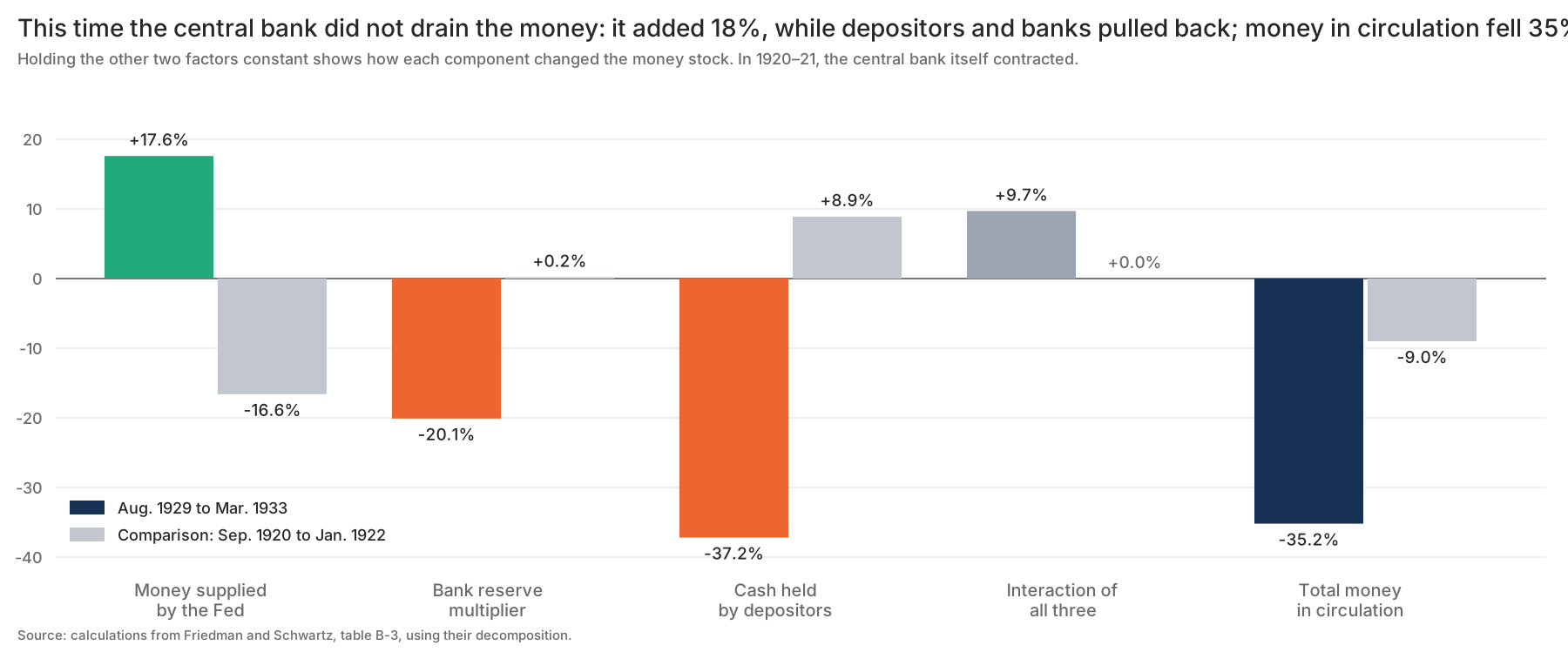
Now the first puzzle can be answered completely. The stock market crash only removed one layer of leverage, and it alone was not enough to cause the Great Depression. The reason why the recession is getting deeper year by year is because falling prices have made everyone more and more in debt, and banks are disappearing one after another, taking society's money with them. By March 1933, approximately nine thousand banks had disappeared in the United States. During the same period, not a single Canadian bank failed.
One Hundred and Eight Days
The third lock is the gold standard. It was triggered in the summer of 1931, in Europe.
At 9:30 on the evening of Monday, May 11, 1931, Austria's chancellor announced that the country's largest bank, Creditanstalt, had lost all its capital. From that night until Britain abandoned the gold standard in September, 108 days elapsed.
Creditanstalt was a relic of an earlier age. Before World War I, Austria had been an empire of 50 million people, and the bank served that entire empire. Defeat in 1918 broke the empire into six or seven countries, leaving Austria with only seven million people. The bank remained in Vienna, while many of its customers now lay beyond the new borders. It never shrank with the country: by 1930, its balance sheet was as large as the Austrian central government's entire annual expenditure. Its losses had accumulated over years. It used deposits that foreigners could withdraw within months to finance factories whose investments would take a decade to repay, and—with government encouragement—it absorbed several even weaker banks. A handful of large customers brought it down: its ten largest borrowers accounted for 40% of the total loss. The bank reported a loss of 140 million schillings against capital of only 125 million.
The Austrian Central Bank followed the textbook exactly: in times of panic, it opened up lending and provided as much as the bank required. This is exactly what the lender of last resort mentioned above should do. But there is a premise that is not written in the textbook, that is, savers will go home with peace of mind after receiving the banknotes. Not so with the Austrians. Like the Germans, they had just experienced hyperinflation that turned banknotes into useless paper ten years ago. After they withdraw their shillings from the bank, they don't go home. Instead, they turn around and exchange the shillings for dollars and Swiss francs, or buy fabrics, furniture and jewelry. By the end of that month, the Austrian central bank's gold and foreign exchange reserves were down by nearly a third. Money to bail out banks has turned into money to run on the national currency.
This is the crux of the gold standard. In a system where banknotes can be freely exchanged for gold and foreign exchange, the central bank has two things in front of it: one is to save its own banks, which requires more money; the other is to defend gold reserves and the exchange rate, which requires less money. Usually the two things do not conflict. When there is a panic, the money released to rescue the bank will be exchanged for gold and foreign exchange and shipped away. It can only choose one of two things, and either one will be a disaster.
Austria could not save itself; it needed a foreign loan. Central banks spent three weeks assembling $14 million. By the time the money arrived, it was gone within a week. France then turned a second loan into a political bargaining chip. Germany and Austria had announced plans for a customs union that March. France saw it as the first step toward a merger expressly prohibited by the peace treaty, so it imposed a condition: Austria could have the money only if it abandoned the customs union. U.S. president Herbert Hoover also intervened. On June 20, he proposed a one-year suspension of all intergovernmental reparations and war-debt payments. It was a sound idea, but he had warned everyone in advance except France, the largest recipient of reparations. French anger delayed agreement for another sixteen days.
While the countries argued, the fire had already reached Germany. On June 17, a large wool company in the northern city of Bremen declared bankruptcy after losing a bet on rising wool prices and falsifying its accounts to hide the damage. Its largest creditor was Danatbank, Germany's third-largest bank. As the news spread, Danatbank lost 40% of its deposits during June. German banks were particularly vulnerable to a run: for every 100 marks of deposits, they held only 3.6 marks in cash, compared with 13.9 in France and 11.7 in Britain.
The president of the Reichsbank was Hans Luther. Standing directly in his way was the 40% reserve requirement described earlier. On June 30, the Reichsbank's reserve ratio was 40.1%, barely above the legal floor. Although there was still gold in its vault, almost none of it was usable. Rescuing Danatbank would require issuing more banknotes, which would push the reserve ratio below 40% and break the law; refusing to act would allow the bank to collapse. Luther became the first central-bank governor in history to fly from capital to capital in a chartered aircraft seeking help. In three days he visited four cities and tried to borrow $1 billion. Two months earlier, governments had spent three weeks haggling over $14 million. On the train to Calais, Luther laid out the figures for Bank of England governor Montagu Norman: Germany's annual output had shrunk to $13 billion; it owed $9 billion in reparations and another $6 billion in private foreign debt, including $3.5 billion of short-term loans that could be withdrawn at any time; only about $250 million in gold remained. Norman knew before the train arrived that the situation could not be saved.
The really rich country is France. France was willing to borrow up to $300 million on the condition that Germany gave up its customs union with Austria, stopped building two battleships, and banned domestic nationalist groups from taking to the streets to demonstrate. Looking at these conditions one by one, they are not all unreasonable, but taken together, they are equivalent to asking the German government to admit defeat in front of the whole country. Domestic politics in Germany were already tense. In the elections in September of the previous year, the Nazi Party led by Hitler soared from 810,000 votes to 6.4 million votes, becoming the second largest party. In this atmosphere, no German government can survive.
On July 13, every bank in Germany closed. The government faced two choices: devalue the mark, or impose controls requiring all foreign currency to be sold to the central bank. When foreign debts matured, payment in marks could be deposited only in a domestic account and could not be transferred abroad. Germany chose controls rather than devaluation. The generation then in power had watched money turn into wastepaper during the hyperinflation of 1923; no German politician dared even utter the word "devaluation." The Reichsbank's reserve ratio later fell as low as 25%, yet the sky did not fall. The difference was that the door had been shut and gold could no longer flow out. From that point, Germany had effectively withdrawn from the international financial system as it had previously existed.
London's turn is next. London has been doing the same business for hundreds of years: people from all over the world deposit temporarily unused money in London, and London then lends this money to places around the world that need money, many of which are lent to Germany and Central Europe. Now that the door between Germany and Central Europe is closed, the money lent by London cannot be recovered, but the money deposited by others in London can be withdrawn at any time. Gold from the Bank of England began to flow out of the country.
Keynes saw this clearly in July, writing privately to the Prime Minister that it was certain that sterling could not hold its current price. But almost everyone in power diagnosed the disease wrongly. Bankers in London, Paris and New York agreed that the problem was that the British government was spending too much and running a budget deficit. As long as the budget was balanced, foreign confidence would be restored. The Labor Party was in power at the time, a party that came to power on the votes of workers, and in order to balance the budget, benefits to the unemployed had to be cut. The cabinet was so divided over the issue that it collapsed in August, replacing an all-party coalition government that took action. But an unbalanced budget cannot change how much money London owes others and has to repay at any time.
In the end, one shilling a day helped break the pound. The coalition government's austerity plan cut naval pay by one shilling per day regardless of rank—a severe loss for the lowest-paid sailors. On September 14, sailors at the Scottish port of Invergordon refused to muster for sea duty. A disturbance in the navy of the British Empire sent the same message to markets everywhere: Britain had reached the limit of what it could cut. Gold then poured out of the Bank of England: £3.5–5 million on September 16, £10 million on the 17th, and nearly £19 million on the 18th. On September 21, Britain announced that it would stop converting pounds into gold. It had abandoned the gold standard.
Norman, who had defended the old exchange rate for six years, was aboard a ship returning home. He was still two days from shore and had not brought his codebook. The Bank's deputy governor had no choice but to send an uncoded telegram whose message was, in effect: Sorry, we have to leave tomorrow and cannot wait for you.
The pound fell from $4.86 to $3.75 within days. The feared catastrophe never came, and not a single British bank failed. Over the following months, twenty-five countries followed Britain off gold. Keynes wrote that week that few Englishmen were not delighted to be free of the golden fetters. That same weekend, Churchill hosted Charlie Chaplin at his country house. As dinner began, Chaplin declared that returning to gold at the wrong exchange rate in 1925 had been a serious mistake and proceeded to display a surprising command of the subject. Churchill remained silent until Chaplin speared two bread rolls on forks and performed the dance from The Gold Rush.
Looking back on these one hundred and eight days, no one wanted this ending. The Chancellor of Austria wants to save a bank, Luther wants to borrow a billion dollars, the British cabinet wants to balance the budget, France wants Germany to abandon the customs union, and everyone is doing what is required of him in his position. What really matters is time: in May, the fight for $14 million took three weeks; in June, it took sixteen days to negotiate for a moratorium on reparations; and in July, it took three days to negotiate for $300 million. Every negotiation has been completed according to the procedures considered reasonable by all parties, and every time it has been completed, the situation has slipped a lot forward.
The Country with the Most Gold
As soon as Britain gave up the gold standard, people immediately asked: Will the United States be next? The central banks of various countries all have some U.S. dollars in their hands. They are worried that the U.S. dollar will also depreciate, so they quickly exchange the U.S. dollars for gold from the United States. In six weeks, $725 million in gold was withdrawn.
The Federal Reserve responded by raising interest rates from 1.5% to 3.5% within a week, hoping to use high interest rates to keep money. This is a standard action of the gold standard. As mentioned before, if gold flows out, interest rates must be raised. But please pay attention to the financial situation of the United States at that time: the Federal Reserve’s gold reserve ratio was 56.6% at its lowest, and the bottom line required by law was 40%. Germany was struggling close to the 40% line that summer, while the United States was standing at a high of 56%, raising interest rates in the midst of an unprecedented recession.
As a result, U.S. banks were squeezed from both sides: foreigners came to withdraw gold, domestic depositors came to withdraw cash, and the Federal Reserve was still raising interest rates. Two thousand two hundred and ninety-three banks closed in all of 1931, the most in one year in American history.
1932 was the bottom. The Dow fell to forty-one in July, nearly 90 percent below its September 1929 high. In 1929, all U.S. companies combined made nearly $10 billion in profits; in 1932, they combined lost $3 billion. More than 10 million people are unemployed.
The Fed actually got it right once this year. It bought about one billion U.S. dollars in government bonds and released the money, and by the summer prices and production both rebounded. However, it did not do so voluntarily. It was because someone in Congress proposed a bill to directly print money. The Fed was afraid that Congress would actually do this, so it acted preemptively. As soon as Congress adjourned in July, the Fed pulled the plug. When it stopped, there was nothing outside pushing it.
Another rescue effort that year failed because of the word "public." Hoover created the Reconstruction Finance Corporation to lend to banks with liquidity problems. At first it worked well. Congress then required disclosure of the banks that had borrowed, intending to prevent favoritism. Once the list became public, depositors immediately ran on the named banks. After that, few banks dared borrow from the agency—just as they needed money most. The lesson is simple: for a lender of last resort to be effective, borrowing from it cannot itself become a mark of disgrace.
The final collapse took only eighteen days and was caused by a small sum of money. In February 1933, a banking group in the Motor City of Detroit had problems, and the government wanted its major shareholder, automobile magnate Henry Ford, to take the lead in getting the money out. Ford refused to pay a penny. He believed that the government would not really let the bank fail. On February 14, Michigan’s governor ordered banks across the state to close for eight days. Prior to this, no bank in Detroit had been run. But this order taught depositors across the country one thing: banks can be closed at will. So people from neighboring states rushed to get money before their own state issued the order, and one state after another was closed down. As of March 4, forty-eight states across the country have enacted some form of bank holiday or withdrawal restrictions.
This returns us to the opening night and answers the second puzzle. The United States had enough gold; its banks were failing. The Fed regarded small banks in the interior as outside its responsibility, while the major banks believed that the creation of the Fed had relieved them of any duty to rescue their peers. No one owned the space between. Gold alone could not help: the people managing it stood at a 56% reserve ratio yet behaved as though they were pressed against the 40% legal floor. The rule that trapped them was not written in law. It was lodged in their minds.
Three Locks
Now look at these five years together. The pressure passed through three places.
The first is debt. The money owed is fixed, but prices and incomes are falling, and the repayments are getting heavier.
The second place is the bank. Deposits are usually equal to money. In times of panic, everyone has to convert them into cash. The bank has to call back the loan, and the money in society disappears.
The third place is the gold standard. If the central bank wants to release money to save banks, it may lose gold and the exchange rate; if it wants to maintain the exchange rate, it must tighten money during a recession.
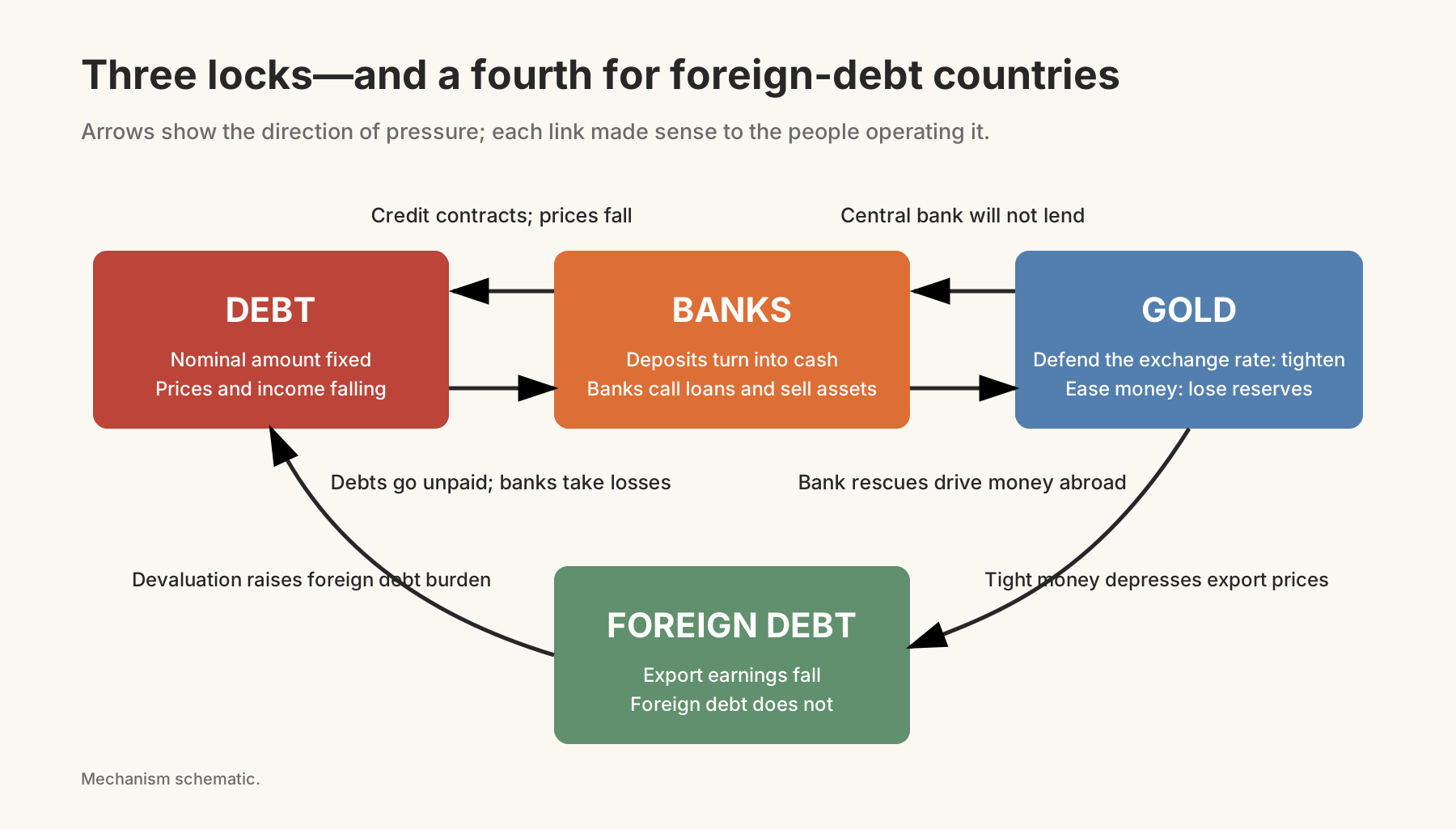
The three locks reinforced one another. When banks contracted, prices fell; when prices fell, debts grew heavier; when more borrowers could not repay, banks weakened further. Defending the exchange rate required tighter money, but tightening deepened the slump and reduced government revenue, making markets even less confident that the exchange rate could hold. Countries with foreign-currency debt faced a fourth lock: export earnings fell while the nominal amount of foreign debt did not, and their central banks could not print dollars or pounds. Even the movement of goods became trapped. Countries raised tariffs, restricted imports and controlled foreign exchange in self-defense, while banks stopped financing trade as they once had. Even willing buyers and sellers found it difficult to complete a transaction.
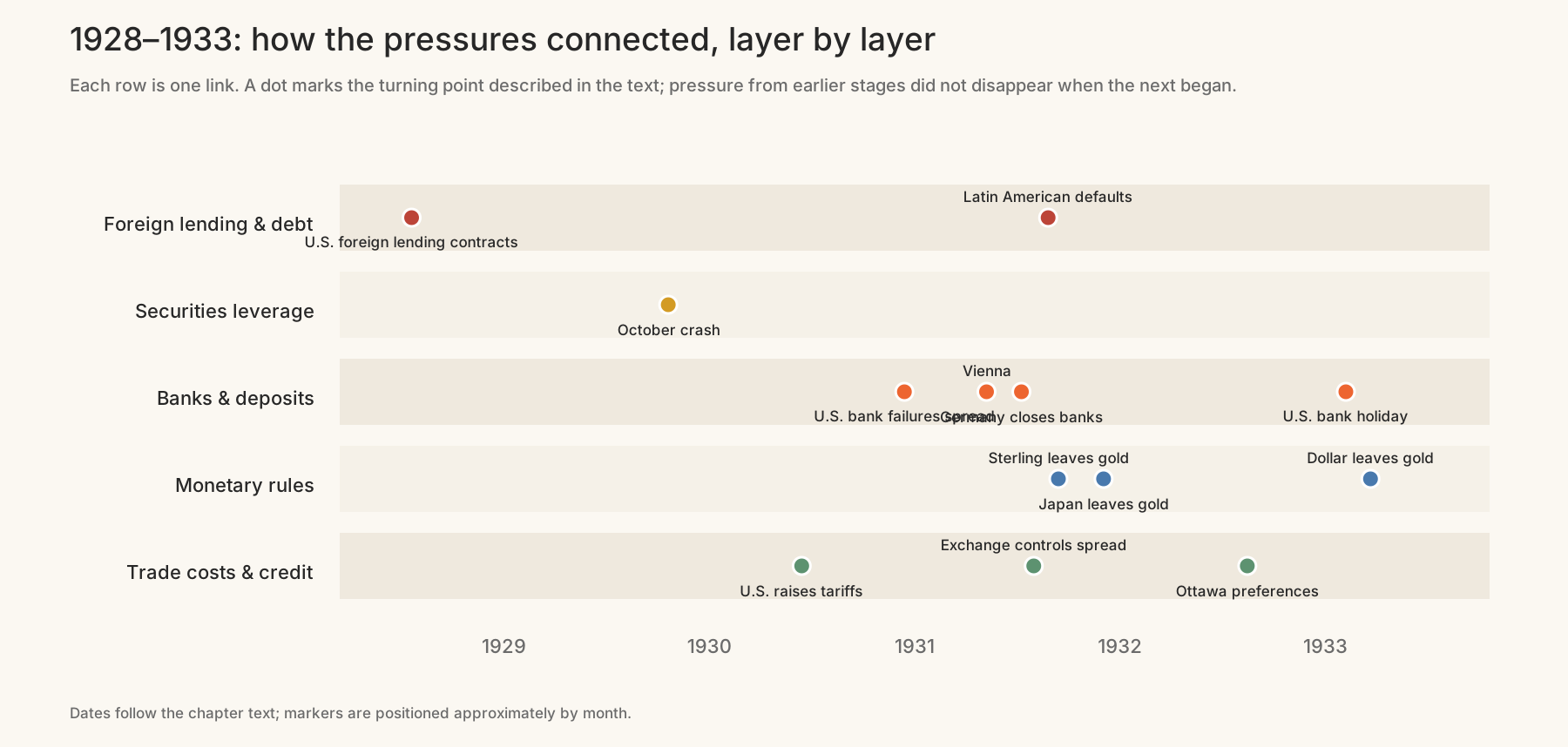
As you can see from the picture, each transition does not eliminate the pressure from the previous stage, but only adds another layer on top. Those in power often struggled with the problems of the previous stage: in 1930 they focused on stock market speculation, and in 1931 they focused on exchange rates and budgets. By then, what was really spreading was bank failures and debt.
III. People
We talk about numbers so much that it’s easy to forget that there are people behind the numbers. Here we only talk about two small places.
There is a village in Austria called Marienthal, and the whole village relies on a textile factory for its livelihood. From 1929 to 1930, the factories closed down in batches. Of the 478 households in the village, 367 had no one working. A team of researchers came to the village to find out what long-term unemployment would do to people. They asked villagers to write down how they spent their day. On the timetable handed in by a thirty-three-year-old unemployed man, there was a line that read: Eleven to twelve o'clock, blank. The researcher also stood on the main street of the village with a stopwatch and counted people. On a 300-meter stretch, 39 out of 68 men stopped more than three times. They have nowhere to go. In the past, the factory whistle divided the day into segments, but now 88 out of 100 men don’t even wear a watch.
To the researcher's surprise, this village, where almost the entire village was unemployed, did not become radicalized. In three elections, the same party received 80%, 80%, and 79% of the vote, without any change. People just quit bit by bit: the library canceled the borrowing fees, and the number of people borrowing books fell by nearly half. The researchers asked the children to write an essay titled "What I want for Christmas" and then converted these wishes into money. The average child in the neighboring village wanted something worth thirty-six shillings; the child in Marienthal only dared to think about twelve shillings. One girl wrote: I would have asked the Holy Child for many things. I got nothing but a pair of glasses.
Across the Atlantic, in a Midwestern American town of 46,000 people, one household in four was living on relief in 1933. The local evening paper published a letter from a housewife. Relief came not as cash but as food orders. The weekly allowance had been two dollars, until an official decided that any woman could prepare forty-two meals for two people on a dollar and a half and cut it by fifty cents. She wrote that the household had gone for weeks without toothpaste and that buying a bar of soap meant crossing an item off the food list. She ended: There is no work, no hope—only getting through one day after another. Perhaps better days will come. Personally, I doubt it.
The first thing unemployment takes away from people is not their political attitudes but the shape of their time, their dignity at home and their plans for the future, almost silently.
IV. The Way Out
Why Devaluation Became the Way Out
The time when countries emerged from depression varied widely, with a gap of four to five years between the earliest and the latest. Taking their methods apart, there are actually only two things, which can be called two keys.
The first key is external: abandon the gold standard and devalue the national currency. This sounds like admitting defeat, but why can it actually save lives? Let’s talk about it layer by layer.
First, the central bank's hands were freed. Under the gold standard, a central bank had to raise interest rates and tighten money whenever gold flowed out—even when the country was already in acute distress, as the United States was in 1931. Once it stopped defending convertibility, it could lower rates and lend freely to banks without fearing that the new money would immediately be converted into gold and shipped abroad.
On the second level, prices no longer fall. After the currency devalued, imported goods became more expensive, and more importantly, people began to believe that prices would rise. As mentioned before, the most painful thing in the Great Depression was the debt that became heavier and heavier. Once prices stop falling and rebound, the lock is reversed: the farmer can sell his wheat at a higher price, and his debt becomes lighter.
On the third level, domestic products have become cheaper in foreign countries, making exports easier.
Among the three layers, the most important ones are the first two. Some people may ask, if all countries devalue, wouldn’t no one be able to take advantage of exports? This is true, but the first two benefits will not offset each other: each country can relax monetary policy, and each country's prices can stop falling.
The second key is internal: fix the bank so that depositors dare to deposit money back and then release the money. Even if the value is depreciated but the banks are still paralyzed, the money cannot reach the people who need it.
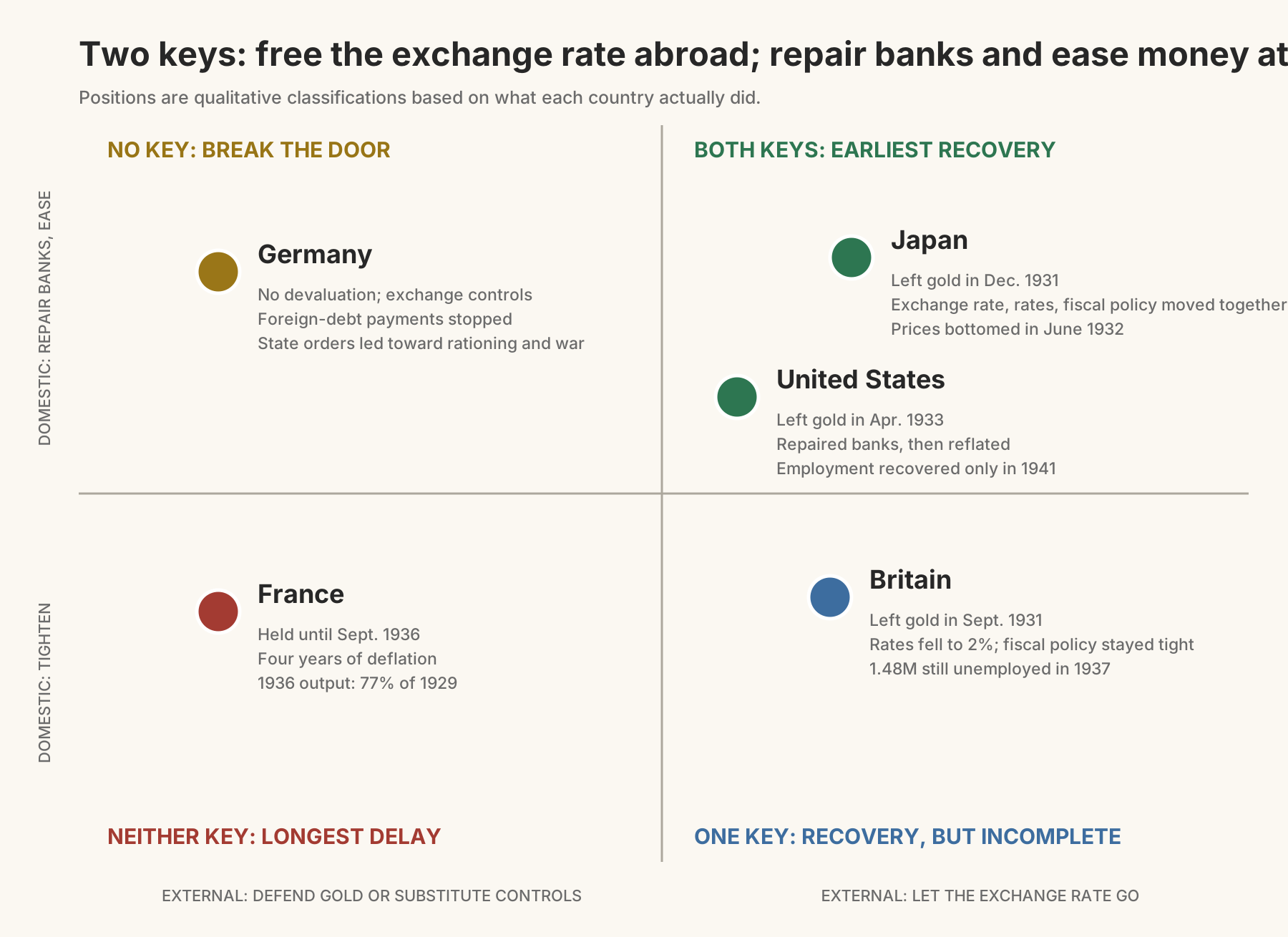
Countries that use both keys will return the earliest, those that use only one will be slower, and those that don't use either will be the last. Let’s look at them one by one.
Using Both Keys: Japan and the United States
Let’s talk about Japan first. It is the earliest among the major countries.
Japan had returned to the gold standard only in January 1930. The timing could hardly have been worse: it coincided with a worldwide depression. Finance Minister Junnosuke Inoue presided over the move. He believed Japan could restore the yen's credibility only by enduring a period of painful austerity. Over the next two years prices plunged, with rural areas suffering most. Even after Britain left gold, Inoue held on for another eighty-three days.
On December 13, 1931, the cabinet changed, and the seventy-seven-year-old Korekiyo Takahashi was invited out of retirement to take over as Minister of Finance. Takahashi is a veteran of Japanese politics. He has served as prime minister and has been in charge of finance many times. On the day he took office, he announced that the government would no longer support the yen's exchange rate by shipping out gold and borrowing foreign debt, which was tantamount to abandoning the gold standard.
Takahashi's sequence was clear: move the exchange rate first, cut interest rates second, and expand government spending last. The yen lost nearly a third of its value in the final two weeks of December and, a year later, was worth only 40% of its former value. The Bank of Japan then cut rates four times, from 6.57% to 3.65%. Only after that did the central bank begin buying government bonds to finance a larger fiscal program.
Takahashi is often said to have pulled Japan out of deflation by printing vast amounts of money, but the numbers do not support that account. A year after he took office, the volume of banknotes in circulation was only 7.5% higher. The decisive change was in expectations: by making clear that it would no longer defend the exchange rate, the government effectively told the public that prices would rise. Businesses expecting higher prices had a reason to order goods and hire workers immediately. Japan also benefited from having reorganized its banks during a panic in 1927, so it did not need the extensive bank repair later required in the United States. Japanese prices bottomed in June 1932, while U.S. deflation continued into 1933. Japan's exports rose from 1.15 billion yen in 1931 to 2.7 billion in 1936.
The two approaches confronted each other directly in Japan's Diet. In January 1932, after leaving office, Inoue asked why Japan alone should expect to recover while the whole world remained in depression. Devaluation, he warned, would invite foreign retaliation, and government spending would spiral out of control. Takahashi replied that farmers and fishermen worked from morning to night without thinking about exchange rates—and that no one in government had thought on their behalf. Applause interrupted Takahashi thirty times; as Inoue spoke, lawmakers rose and left. Nineteen days later, a twenty-year-old assassin shot Inoue while he campaigned for a fellow party member. With rural Japan in distress, extremists blamed pro-austerity politicians and industrial magnates and carried out a series of assassinations. In fairness, much of Inoue's forecast came true: other countries retaliated, and government spending did become uncontrollable. He lost the argument because no one would accept a plan that asked the country to endure two more years.
Takahashi’s own ending will be discussed later when we talk about Germany.
Let’s talk about the United States. The United States uses the internal key first.
Roosevelt took office on March 4. The first thing he did after taking office was to close all the banks that the governors had already closed half of, and then reopen them in batches: first open those banks that were confirmed to be healthy, then open those that needed help from the government, and never reopen those that were really insolvent. At the same time, the Treasury Department assured the Federal Reserve that if the Federal Reserve lends money to banks that reopen, if there are losses, the government will compensate. This is equivalent to the government guaranteeing every bank that reopens. Ironically, the draft of this plan was drafted by Hoover's staff.
During those eight days when banks were closed, Americans' lives were better than they imagined. Shopkeepers gave customers credit, doctors and lawyers collected IOUs, and more than a hundred towns printed their own temporary vouchers. One department store in Detroit simply accepted the produce as payment for the goods, exchanging a skirt for three barrels of herring, and three pairs of shoes for a 500-pound sow. The most lacking thing was change. The subway fare in New York was five cents. People at the bank said that there was a "nickel shortage" in the whole city.
At ten o'clock on the evening of March 12, Roosevelt delivered his first national radio address to an audience of sixty million. He offered no grand theory. In plain language, he explained what banks did with deposits, why they had closed and how they would reopen one by one. He concluded that money was safer in a reopened bank than hidden under a mattress. The next day, long lines formed again—but this time people came to deposit money. Within a week, $1 billion in cash had returned to the banks.
Why does the same plan work if only one person is changed? The reasons are very specific. Depositors knew that the government was behind the reopened banks; every bank opened its doors after checking their accounts, and opening the door itself was a certificate of compliance; the whole country closed and opened together, and depositors no longer had to worry about neighboring states closing first and rushing to withdraw their money; in addition, Hoover said so many times that "the worst is over" that people no longer believe him.
Roosevelt used the second key in April. Over the objections of every economic adviser around him, he announced that dollars would no longer be redeemable for gold at a fixed price. The United States did not lack gold. Britain and Japan had set a precedent, Congress was applying pressure, and farm prices had fallen too low for farmers to survive. The effects appeared quickly: agricultural prices rose about 40% from March to July. Later research comparing counties found that car sales recovered faster where farm prices rose more; among counties with similar price gains, consumption rebounded most strongly where farm debt had been highest. The debt lock had begun to turn in reverse.
But for devaluation to reduce debt, one more obstacle had to be removed: the contracts themselves. About $120 billion of U.S. debt carried a "gold clause" requiring repayment in gold value. For every percentage point the dollar depreciated, these debts would become a percentage point more expensive to repay, canceling the benefit of devaluation. Yet all the gold in the United States was worth only $3–4 billion. In June 1933, Congress voided every gold clause in public and private contracts. Creditors sued, and in 1935 the Supreme Court upheld the outcome by five votes to four. Its reasoning was circuitous: the government had acted wrongly, but the plaintiffs had suffered no compensable loss. In January 1934, the dollar was again pegged to gold at $35 an ounce, up from $20.67, amounting to a 40% devaluation.
Of all these measures, the one that endured longest was the one none of the leading figures initially wanted: deposit insurance. If a bank failed, a dedicated agency would reimburse insured depositors, removing the reason for a run. Between 1886 and 1933, Congress considered 150 deposit-insurance bills; 147 never made it out of committee. This time the provision was folded into the Banking Act of June 1933. The effect was immediate: 4,004 U.S. banks failed in 1933, but only 61 failed in 1934.
There are two things that are often misunderstood about Roosevelt's "New Deal." One is that it relies on the government spending a lot of money. In fact, the increase in money in the United States from 1933 to 1936 was almost entirely due to the re-pricing of gold. Coupled with the unstable situation in Europe, gold continued to flow into the United States. The government's fiscal stimulus amounted to only 3 to 4 percent of national output, and savings were being made within the New Deal, with Roosevelt cutting public employee salaries by 15 percent in his first month in office. The other part is that the recovery will be smooth sailing from now on. From 1936 to 1937, the Federal Reserve, worried that too much spare money in banks would cause inflation, doubled the proportion of reserves that banks were required to keep, the Treasury froze incoming gold, and government budgets were tightened at the same time. All three brakes were applied, and from May 1937 to June 1938, industrial production fell by approximately 32 percent, and unemployment returned to 20 percent. After the brakes were released, the economy started to move forward again. Calculating the general ledger, by the spring of 1937, U.S. production, profits, and wages returned to the levels of early 1929, but employment did not truly recover until the United States entered World War II at the end of 1941.
Using One Key: Britain
Britain's recovery has been anything but dramatic. There have been no big projects and no politicians have announced grand plans. It just does three things in sequence, the second of which, at first glance, seems to be the opposite of recovery.
The first was being forced to give up the gold standard, which I mentioned earlier. The second thing is to continue to balance the budget and keep interest rates at a high 6% for a few months. why is that? Because the pound has just fallen, the whole world is asking: Will it fall all the way and become a piece of waste paper? Tightening the budget and raising interest rates are the answer: no. After everyone believes this, they will do the third thing and make money cheaper. The Bank of England took four and a half months to cut interest rates from 6% to 2% and then stayed there for seven years.
The most elegant operation of this period was the conversion of Britain's war debt. More than £2 billion of bonds issued during the war paid 5% annually; as long as such a large block of debt yielded 5%, other long-term borrowing could not become much cheaper. On June 30, 1932, the government offered holders a choice: exchange their bonds for new ones paying 3.5%, or take back their principal. Ninety-two percent chose the exchange because the market offered nowhere better to put the money. The preceding months of fiscal restraint had lowered market rates by convincing investors that Britain would not inflate. Credibility came first, monetary easing second; the order mattered.
The cheap money was first caught by those building houses. Privately built housing in Britain increased from 133,000 in 1931-32 to 293,000 in 1934-35.
But Britain stopped there. It used the external key and cheap money, while the government itself remained unwilling to spend more. In 1937, 1.48 million people were still unemployed, concentrated in the old industrial regions of Wales, Scotland and northeastern England—places that saw little of the housing boom.
Using Neither Key: France
France held on until 1936—precisely because it could. The franc had initially been set low, gold kept flowing into France, and its vaults were full. Unlike sterling, the franc was never forced to the brink of collapse in a single day. Government after government fell amid conflict over budget cuts, but none fell directly because of the exchange rate. The delay lasted four years: prices declined year after year, and business became steadily more difficult.
France's aversion to devaluation had deep roots. The franc had lost 80% of its value in the 1920s, wiping out countless people's savings. A second devaluation looked like robbing savers twice. No faction, from the far right to the Communist Party, dared advocate it. By the end of 1935, most members of Parliament privately accepted that devaluation was inevitable, but no one dared say so in public.
In June 1936, the Popular Front coalition of left-wing parties came to power, and Socialist leader Léon Blum became prime minister. He privately understood the need to devalue but repeatedly promised that he would not, trapping himself until September, when delay was no longer possible. The gains from devaluation were partly offset by another policy introduced at the same time: the statutory workweek fell from forty-eight hours to forty without a cut in weekly pay. France was producing fewer hours at higher cost. Industrial output in 1936 was only 77% of its 1929 level, last among the twenty-three comparable countries.
Leaving the Locks Shut and Breaking Down the Door: Germany
Germany took the third path. Instead of using keys, it dismantled the entire door.
First consider Germany before it broke down the door. Heinrich Brüning served as chancellor from 1930 to 1932. Without a majority in the Reichstag, he governed through emergency decrees signed by the president. Decree followed decree, each with the same substance: cut wages, reduce civil-service pay and compress government spending. The number of unemployed Germans rose from three million to six million, earning him the name "Hunger Chancellor."
Brüning's record needs to be judged in parts. Some constraints were beyond his control: the 40% reserve requirement was written into an international agreement that he could not change. In 1932, the gap in the German economy exceeded 30 billion marks, while even the most ambitious stimulus plan proposed at the time was only about 2 billion. But one choice was his own. He used mass unemployment as a bargaining chip, hoping Germany's misery would prove to creditors that reparations were unpayable. The tactic ultimately worked. Brüning was forced from office in May 1932, and reparations were formally canceled a few weeks later—but he was not the one who reaped the political reward. In January 1933, Hitler became chancellor.
Hitler's Germany did not devalue the mark. The foreign debt it owes is denominated in foreign currencies, and the debt will be heavier once it depreciates, and the central bank has almost no gold left. It uses a different approach. Externally, the repayment of foreign debts will be stopped, foreign exchange will be uniformly distributed by the state, imports must be approved, and when doing business with other countries, exchange goods for goods as much as possible. Domestically, the state places direct orders, mainly arms orders. When the government places an order with an arms dealer, it does not pay cash but a special note. This kind of note is in the name of a shell company, has interest, and can be taken to the central bank and exchanged for cash at any time. It is not included in the government budget nor the national debt. Outsiders cannot see from the books that Germany is expanding its military on a large scale. The person who designed this approach was Schacht, the central bank governor appointed by Hitler. He was Germany's most famous financial expert. It was under his hands that the hyperinflation in 1923 was stopped.
Spending on that scale should have raised prices. Germany suppressed the increase through coercion: wages were frozen, trade unions banned and price increases prohibited. When prices could no longer allocate scarce goods, rationing and administrative approval took their place.
There is also a widely circulated saying that Hitler solved unemployment by building highways. This is not true. When construction began on the first section of the highway in 1933, there were no more than a thousand workers on the site. All job-creating projects combined can only explain at most 30% of the decline in unemployment. Germany's recovery started very early and relied on military expansion. Shortly after he came to power, Hitler said at a cabinet meeting that Germany's future depended on only one thing, the rebuilding of the army, and everything else had to make way for it.
The approach hit a wall every few years. By the summer of 1934, the Reichsbank had enough foreign currency to cover only one week of imports. Another crisis came in 1936. By then, even leading conservatives and major industrialists supported devaluation and deregulation. Leipzig mayor Carl Goerdeler was commissioned to write a comprehensive assessment. He concluded that other countries would not tolerate German exports subsidized by the state indefinitely and urged a return to normal economic policy. Hitler answered with a handwritten memorandum: from now on, every economic measure would be based on the imminence of war. Each time the system reached its limit, the regime chose more controls and more armament.
By January 1939, Schacht and the central bank governors jointly reported to Hitler that there was no gold and foreign exchange reserves left, and the only way out was to strictly control expenditures. Schacht was dismissed from his post that month.
We can now return to the fate of Korekiyo Takahashi, because Japan had reached the same point as Germany. Having the central bank finance government spending was the right medicine while the economy was depressed and factories stood idle. But by around 1935, Japanese factories were already operating near capacity; continued expansion now threatened inflation. To rein in spending, Takahashi first had to cut military outlays. The armed forces' appetite had grown: in 1935, military spending consumed 46% of the government budget. Officers came to see the elderly finance minister as an obstacle to expansion. Early on February 26, 1936, young army officers led troops in a coup attempt, broke into Takahashi's home and murdered him in his bed. He was eighty-one. Afterward, the post of finance minister became one that no holder dared exercise with the same resolve.
The stories of Germany and Japan tell the same thing: asking the central bank to advance money for the government is easy to start but difficult to stop. When the person in charge of the money wants to collect it, the person with the gun in his hand won't let him.
Different Locks: Peripheral Countries
The above mentioned are all big countries. Countries in Eastern Europe and Latin America that rely on exporting food and minerals are in a different situation. What traps them first is foreign debt. For them, depreciation alone is not enough, because the debt is owed to US dollars and pounds. Once the national currency depreciates, the converted debt will become heavier.
Argentina and Chile are just a comparison. Argentina stopped converting gold in December 1929, one year and nine months earlier than Britain, but it insisted on repaying its foreign debts honestly. What little room was left freed by devaluation was eaten up by debt repayments, and it took until 1934 for prices to return to their 1929 levels. Chile abandoned the old rules much later, but at the same time it announced that it would stop repaying its foreign debt, with the result that wholesale prices more than doubled from their nadir in 1931 to 1933. It can be seen that for these countries, changing exchange rates and reducing foreign debt are two different things, and both are indispensable.
At the time, conventional wisdom held that any country daring to default would never borrow again. In practice, so many countries defaulted during those years that markets could not punish all of them indefinitely. The foreign currency no longer spent on debt service could buy essential imports. And when imports became unaffordable, domestic factories began producing goods that had previously come from abroad. Chile's imports fell 89%. Brazilian manufacturing surpassed its 1929 level by 1934 and stood nearly 70% higher by 1937.
Brazil offers a story that sounds absurd. Coffee was its lifeblood, and prices fell 64% in two years. Fearing mass bankruptcy among growers, the government bought unsold coffee and burned it. From June 1931 through 1933, more than 14 million bags were destroyed. Much of the purchase money came from newly issued banknotes. The stated goal was to stabilize coffee prices; the practical effect was to inject money into the economy. Coffee growers spent the proceeds, supporting other industries. The destroyed coffee was, of course, a real waste. The episode shows how expansionary policy was often carried out under some other name.
Some countries in Eastern Europe that are unwilling to openly default on their debts have come up with more devious methods. The same currency is set at several different prices: the official exchange rate remains unchanged and is used to calculate foreign debt, and there is no devaluation on the face of it; when actually doing trade, another exchange rate is used that is 30 to 40% lower. From now on, there will be no need for money at all. Between the two countries, I will give you as much goods as you give me, and only the difference will be settled at the end of the year.
China was a special case. Its currency was the silver dollar: the money itself was silver, whose price was set each day in London. International silver prices fell by half from 1929 to 1931, automatically depreciating China's currency. Thus, while prices fell across most of the world, Chinese prices rose 20%, sparing China the first two years of the Depression. After autumn 1931, however, sterling, the yen and the U.S. dollar depreciated in succession, making the silver dollar relatively expensive. In 1934, the United States passed legislation supporting silver prices to benefit its own silver-producing states, and Chinese silver flowed abroad in a torrent. Silver was money; as it left, the domestic money supply contracted. The countryside broke first: prices received by farmers fell 40% from 1930 to 1933.
The crisis left another lasting legacy in China: the banks changed owners. The Nanjing government lived on bond issuance, with Shanghai banks as the main buyers. When money tightened, those banks refused to buy more. The Bank of China, then the country's largest, led the resistance. Its general manager, Zhang Jia'ao, argued publicly that the interior was declining and Shanghai's prosperity could not last; banks should invest inland. On March 23, 1935, Finance Minister H. H. Kung abruptly announced a 100 million yuan bond issue. Part of it was injected as government equity into the Bank of China and the Bank of Communications, without prior notice to either institution. The government contributed bonds that could not be sold and received control of the banks in return. Zhang later said that the authorities wanted to use the bank as a treasury, whereas he wanted to run it as a bank. Eight months later, in November, the government severed the currency's link to silver and introduced a paper fiat currency. It was no longer redeemable for silver but could be exchanged for foreign currency at the published rate. The central bank maintained convertibility through three subsequent political crises, establishing the new currency's credibility.
The Earlier They Let Go, the Earlier They Recovered
After considering so many countries, can we identify a general rule? Yes. Group the twenty-three countries for which data are available by the year they left the gold standard, then compare industrial output across the groups.
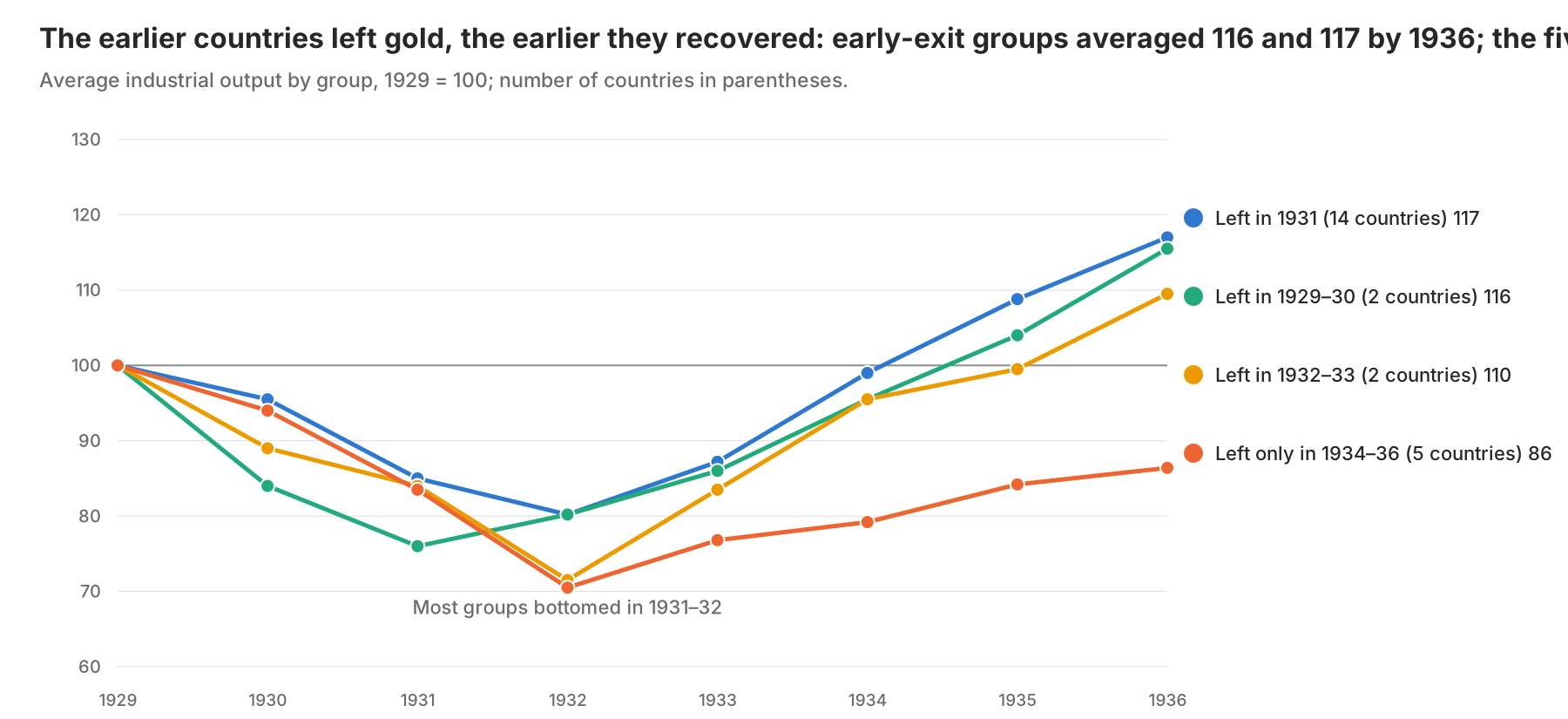
Countries actually hit rock bottom at about the same time. Twenty-two of the twenty-three countries hit bottom in 1931 or 1932. The difference comes after bottoming out. For the two groups of countries that left the gold standard in 1931 and earlier, industrial output by 1936 averaged 116% and 117% of what it had been in 1929, already above what it had been before the crisis. The average of the five countries that held on until 1934-1936 was only 86%, and none of them returned to the 1929 level. Everyone fell into the pit at almost the same time, but five years later, there was a difference of 30 percentage points.
A few exceptions matter because they clarify what "letting go" actually meant. Czechoslovakia and Austria nominally left the gold standard, but relied on exchange controls without easing domestic monetary conditions; their results were as poor as those of countries that clung to gold. Canada let its currency float, but its largest trading partner, the United States, remained on gold until 1933, so the Canadian economy continued to sink alongside it.
The third puzzle can now be answered. Having a large gold reserve only buys more time. The UK has little gold and cannot hold on to it, so it lets go early and recovers early; France has a lot of gold and there is no day when it has to let go, so if it keeps putting it off, the pain will be prolonged for the longest time. At the same time, we must also realize that giving up the gold standard is not medicine in itself. It just unties the rope that binds our hands. What to do with your hands after untying them, whether to repair banks, whether to release money, whether the released money will be used to build houses or make cannons, the fate of each country is divided here.
| Country | External policy | Domestic policy | Outcome |
|---|---|---|---|
| Japan | Left gold in December 1931; the yen fell to 40% of its former value | Cut interest rates; the central bank bought government bonds | Prices bottomed in June 1932; later military spending proved impossible to contain |
| United States | Left gold in April 1933; voided gold clauses | Repaired the banks first, then eased money | Output returned to its early-1929 level in 1937; employment did not recover until 1941 |
| United Kingdom | Left gold in September 1931 | Cut interest rates to 2%; the government declined to spend more | Housing led the recovery; 1.48 million people were still unemployed in 1937 |
| France | Held on until September 1936 | Endured four years of deflation | Output in 1936 was 77% of its 1929 level |
| Germany | Did not devalue; suspended foreign-debt payments and imposed exchange controls | Used state orders, rearmament, and wage and price freezes | Drove down unemployment while moving toward rationing and war |
| Chile | Abandoned the old rules and suspended foreign-debt payments | Imports collapsed; domestic factories filled the gap | Prices more than doubled in two years |
| Argentina | Ended convertibility first, in 1929, but continued to service its debt | Debt service consumed the room created by devaluation | Prices did not regain their 1929 level until 1934 |
V. Lessons
Five Misreadings That Matter Most
After telling the story, let me first clarify some of the most widely circulated misunderstandings.
First, the Great Depression was not caused by the stock market crash. The stock market crash eliminated the leverage for stock trading, banks began to fail en masse at the end of 1930, and the monetary rules of various countries collapsed in 1931. These were three events that were connected but different.
Second, central banks are not helpless. The U.S. Federal Reserve bought billions of dollars in Treasury bonds in 1932, and prices and production rebounded as soon as they did so. It’s not that it has no solution, it’s that it refuses to use it.
Third, Roosevelt’s New Deal cannot alone explain America’s recovery. What put money back into the economy was mainly the repricing of gold and the inflow of gold from Europe.
Fourth, Germany did not solve unemployment by building highways, but by expanding its military.
Fifth, abandoning the gold standard will not have immediate results. It took eleven months for the UK to give up and actually rebound. In the meantime, it also did three things: establishing credit, lowering interest rates, and exchanging national debt for interest.
Who Paid the Bill
Every adjustment made someone pay, but the identity of the payer differed by country. In Britain, the burden fell on people who lived on interest and on the unemployed: the interest rate on government debt fell from 5% to 3.5%, while unemployment benefits were cut 10%. In France, it fell first on civil servants and government-bond holders, and ultimately on all savers. In the United States, creditors protected by gold clauses and foreign holders paid. In Germany, the costs fell on foreign creditors and workers whose wages were frozen. In China, farmers and small and midsize banks bore the burden. The Soviet Union, not examined in detail here, exported grain to earn foreign currency for imported machinery. As grain prices fell, it had to sell more: in 1930 it exported more than twice as much grain as it had a few years earlier, yet earned only 6% more. Farmers paid that bill.
If we make a list of the forty-one major decision-making mistakes that can be identified in this period of history, and look at who the price of each mistake fell on, the result is this: twenty-three, accounting for 56%, fell on workers, farmers, and savers; eight, accounting for 20%, fell on creditors and government finances.
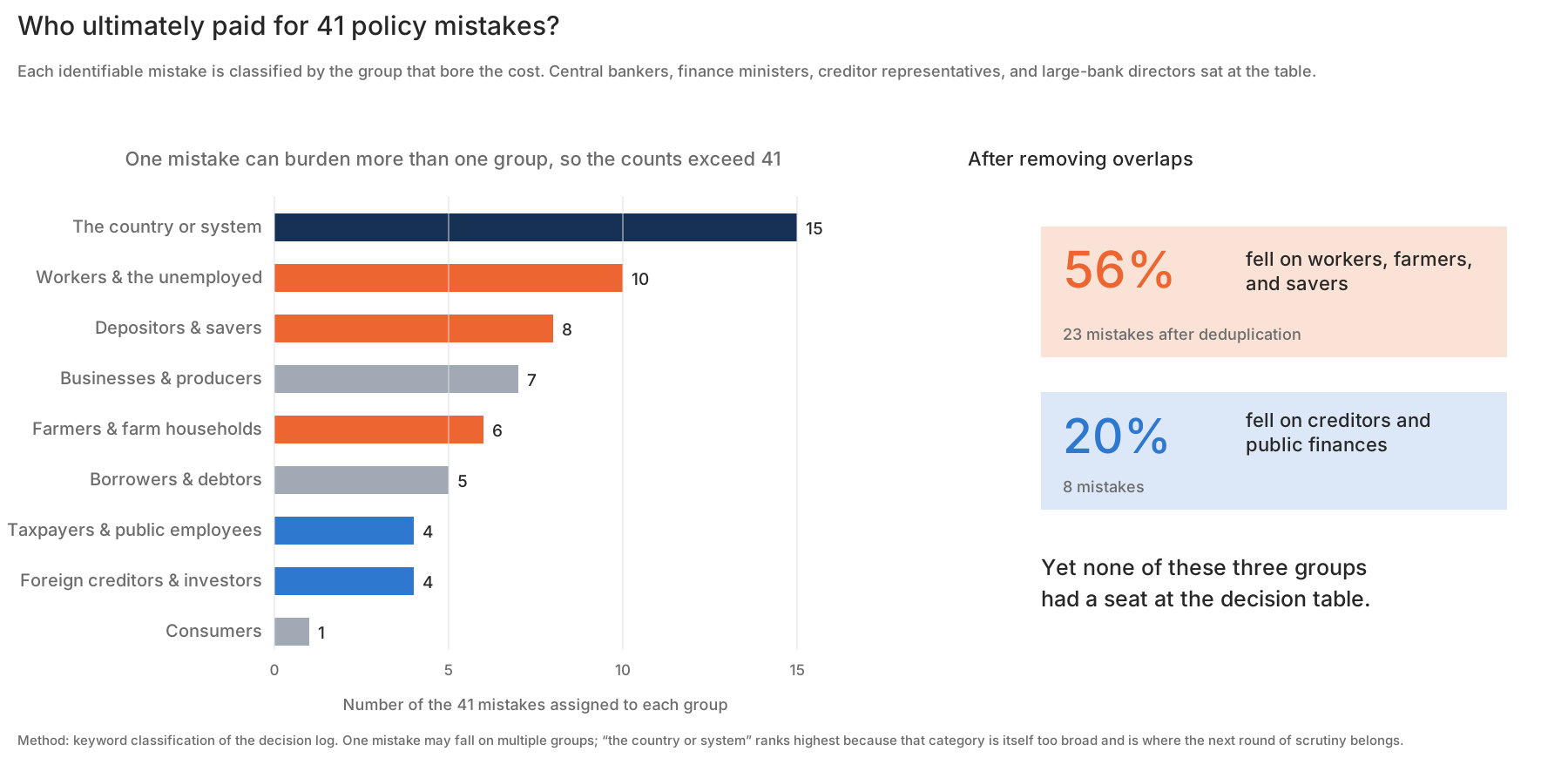
It is worth pondering that none of these three types of people, workers, farmers and savers, sat at the table where decisions were made. Seated around the table were central bank governors, the chancellor and directors of the big banks. The farther apart the people who pay the bills are from the people who make the decisions, the longer a mistake can persist. The exchange rate set by Britain in 1925 lasted for six years, and Germany's austerity policy lasted for two and a half years. The common point is that those who bear the cost do not have the right to say "no".
When prices fall, not everyone suffers. Those who have a fixed amount of income and don't have to worry about defaulting on their debts will have an easier time, such as those who receive interest on national debt, those who have cash in their hands, and those who hold an iron rice bowl. Take Britain as an example. From 1929 to 1933, wages fell by only 4.5% and prices dropped by 14.9%. Therefore, those who kept their jobs saw their real incomes increase by about 12%; at the same time, the unemployment rate exceeded 20%. The fall in prices has divided workers in half. Those who stayed in the factory had a better life, while those who were locked out of the factory bore almost the entire price. This was not arranged intentionally. But it could explain something puzzling: why calls for rule changes have been so slow to gather steam when job losses have become so severe. Because the victims are dispersed, while the protected are closer to the Treasury and the Central Bank.
Five Lessons for Policymakers
For those who hold policy in their hands, this history has left five lessons.
First, we must distinguish what is a contract and what is just a consensus. The authorities often lump the two together when they say "there is no other way." Germany's 40% reserve ratio line is an international contract, and changing it does require creditors to nod. This is a true constraint. "Inflation will occur as soon as we relax" was just what everyone thought at the time, and it can be argued and overturned. A simple way to determine which category a constraint belongs to is to ask: Who needs to agree to lift it?
Second, look at usable reserves, not total reserves on the balance sheet. Recall the Reichsbank at the end of June 1931. Its reserve ratio was 40.1%, and its vault still held substantial gold. But the law required the ratio to remain above 40%. Those forty percentage points were therefore locked by law—visible but unavailable. The amount it could actually spend was the 0.1 percentage point above the floor, effectively zero. Imagine someone with 100,000 yuan in an account who has signed a contract never to let the balance fall below 100,000 yuan: the amount available to spend is zero. In a panic, a central bank must act as lender of last resort and lend freely to banks. A central bank sitting on its statutory floor would break the law with every additional loan and therefore could not perform that role. To judge whether a country can withstand a crisis, do not ask how many reserves it reports; ask how many it can actually use.
Third, if you stick to an exchange rate until you start spending other people's money, you're not far away from letting go. A country first uses its own gold to maintain its exchange rate. When its own gold is used up, it borrows money from foreign countries to maintain its exchange rate. At this point, the remaining time is usually calculated on a weekly basis. Such was the case with the Bank of England in the final days of September 1931.
Fourth, an improving aggregate can conceal a worsening distribution, and the part left behind may never catch up. U.S. output recovered by 1937, but employment did not. Britain's housing industry boomed while its old industrial regions remained depressed.
Fifth, emergency measures create their own beneficiaries. Multiple exchange rates, barter, rationing and permit systems all began as temporary expedients. They became difficult to dismantle because each control placed allocative power in someone's hands, and removing it meant asking that person to surrender power. Exit dates and conditions should therefore be written down when a measure is introduced—before its beneficiaries become an entrenched constituency.
The Investor's Arithmetic
For investors risking their own money, this history contains several hard calculations.
First, being right is not enough. An investor who put up only 25% of the purchase price and borrowed the rest to buy stocks in 1929 could understand a company's long-term value perfectly and still be forced out in the first decline, losing all of the original capital. A factory financed with short-term loans might make products that would eventually be needed and still die in the month its bank refused to renew the loan. The Bank of United States ultimately repaid 83.5% of what it owed. What it lacked was time—and a run allows none. Beyond asking "Am I right?", investors must ask two more questions: if it takes three years to prove me right, can my financing survive until year three? If I am wrong, who can demand payment, on what date, and at what price?
The second, most dangerous combination is that the amount of debt owed is fixed, but the price at which the goods are sold is determined by someone else. This was true for farmers in the 1930s, it was true for exporting countries with foreign debt, and it is true for today's heavily indebted companies that sell commodities and have no pricing power of their own.
The third thing is that the fate of the industry often trumps personal shrewdness. During the recession in the United States in 1938, the output of items used every day, such as soap and food, fell by only 9%, while the output of durable items such as machines and automobiles dropped by 40%. Venezuela in South America has neither depreciated nor defaulted on its debts, but it has escaped the most serious debt crisis simply because it sells oil, which can still make money during the depression; Chile sells copper and saltpeter, which is a completely different fate. Whether a person is a soap maker or a machine tool maker sometimes determines whether he can survive more than how capable he is.
Fourth, the gauges can read backward. Falling nominal interest rates do not necessarily mean that money is becoming easier; the change in prices must be taken into account. Nor does a bank's refusal to borrow from the central bank prove that it has ample funds—it may simply have no business worth doing. In 1930, the Federal Reserve looked at these two readings and concluded that money was already easy. To judge whether credit is tightening, look beyond the policy rate: how much extra interest must weak borrowers pay relative to strong ones? Are bank lending standards easing or tightening? Are small and midsize firms that depend on bank loans suffering far more than large companies?
Fifth, an index can obscure the truth. On the day the Dow peaked in September 1929, only nineteen of more than eight hundred listed stocks reached new highs.
Sixth, leverage hides elsewhere. When banks were restricted from lending to stock speculators in 1929, large corporations stepped in and lent spare cash to securities dealers. Leverage was also embedded in pyramids of investment companies: Company A borrowed to buy shares, and Company B borrowed to buy shares in Company A. With two layers, a 10% fall in the underlying stocks could produce roughly a 20% fall at the top. None of this was illegal, and none of it fell within the Federal Reserve's jurisdiction. Control risk in one place and it will migrate to another that no one regulates.
A Series of “Near Misses” Does Not Mean the Crisis Was Avoidable
People who read this history often feel sad because there are too many "just a little bit" moments in it. The first loan to Austria arrived three weeks late. The plan to save the Bank of the United States was signed almost at half past eight in the evening. The deposit insurance bill was passed by the U.S. House of Representatives in May 1932 but was suppressed by the Senate. If it had been implemented ten months earlier, the national run in February 1933 might have been a different story.
However, these "near misses" cannot simply be added together to conclude that "the Great Depression could have been avoided." Many decisions are driven by the same system, the same ideas, and the same political atmosphere. If you only change one of them, the stress will come from other places.
Crises That Followed
After the 1930s, the world did patch up some holes. The currencies of major countries are no longer linked to gold, and people's small deposits are insured. In times of crisis, central banks of various countries can provide each other with dollars. But there are some things that haven't changed, and they mostly come from the contract itself.
Countries that cannot devalue still have to rely on lower wages and prices. Greece uses the euro and cannot devalue on its own. Its output fell by about a quarter from 2008 to 2013, while unemployment reached 27.9%—comparable to the worst-hit countries of the 1930s. One thing was different, however. In 2012, the European Central Bank pledged to do whatever was necessary within its mandate to preserve the euro. The euro area did not suffer the chain of bank closures seen in 1931. In a system where individual members cannot devalue, the presence of a lender of last resort willing to backstop the system can change the outcome.
Countries that owe foreign currency debts still cannot print foreign currency. This was true for Latin America in 1982 and Asia in 1997.
Runs still happen, they happen in places beyond the reach of deposit insurance, and they happen much faster than before. In 2008, the net value of a money market fund in the United States fell below one dollar. Within a week, approximately $300 billion was drained from similar funds. On March 9, 2023, approximately $42 billion was withdrawn from Silicon Valley Bank in one day, nearly a quarter of its total deposits. The queue at the entrance of the Bank of the United States lasted all afternoon. Nowadays, people can just click a few times on their mobile phones without queuing.
So no matter which crisis we are facing, we can ask the same questions: Who must pay when, and in which currency? When the income is cut off, who can get the cash? Who needs to nod to change this constraint?
Epilogue: Rules Must Deliver Results
Now there is one last puzzle left: There was no shortage of people who saw it right at the time, so why didn’t it work?
Begin with Keynes, who appears throughout this story. In 1936 he published The General Theory of Employment, Interest and Money, a book that transformed how governments responded to recessions. In that sense, he won. Yet in the preceding seventeen years, he had repeatedly been right in advance and repeatedly failed to persuade those with the power to decide. In 1919 he urged the cancellation of war debts and reparations; no one listened. In 1925 he wrote three articles opposing the $4.86 exchange rate, and Britain returned to gold anyway. In July 1931 he warned the prime minister that sterling could not hold. That same month, the Treasury's top civil servant publicly rebuked journalists for raising the question, calling it an affront to national honor. Keynes won in the end because time moved to his side.
So the answer is this: none of the costliest decisions of those twenty-five years was made because no alternative had been proposed. Paul Warburg warned about the stock market in March 1929 and was immediately attacked for obstructing prosperity. Russell Leffingwell had described in 1927 what would happen if every country scrambled for gold. Only ten copies were printed of Carl Goerdeler's 1936 assessment, which clearly identified the limits of German rearmament. Each was numbered, collected after reading, and followed by destruction of the printing plates. When later generations say that "no one saw it at the time," what they often mean is that those who did see it could not get their words into the room where decisions were made. There are always people who recognize the danger. What is missing is an arrangement that lets them speak the truth without bearing the cost of being right alone.
There is another side to the story. Those who defend established rules are rarely stupid or malicious. Norman genuinely believed that preserving the old exchange rate meant preserving Britain's credit. Junnosuke Inoue believed that temporary pain could purchase long-term stability. France's central bankers had lived through a currency collapse and feared inflation above all else. The principles they followed had worked earlier in their lives. A rule becomes most dangerous when it remains unchanged while the world around it has changed—and no bell rings to tell its guardians that it is time to reconsider.
This history offers no easy conclusion such as "rules must always be obeyed" or "the sooner rules are broken, the better." From 1933 to 1937, the United States restored output through peaceful means but failed to restore full employment. Over the same period, Germany crushed unemployment by defaulting on foreign debt, controlling foreign exchange, freezing wages and directing state orders to armaments. The entire world later paid for that path. If one lesson endures, it is this: when a set of rules demands patience, it must prove that the period of suffering can end. If a society cannot restore work within its rules for too long, those who promise to abolish the rules altogether will gain power—and will use it in ways the rules' defenders least want to see.